
Car Depreciation Calculator Australia: The 2026 Guide to Market Value
Your new car loses up to 15% of its value the second you drive it out of the dealership. Within the first year, that figure often doubles. This is a predictable but frustrating reality for Australian drivers who want to protect their investment while balancing tax deductions against actual resale prices. Most owners feel stuck between confusing ATO rules and the fear of a lowball trade-in offer. Using a car depreciation calculator australia helps you cut through the noise by providing a clear picture of exactly where your money is going.
We’ll show you how to master the maths of vehicle value loss so you can make informed decisions before you sell. You’ll learn the difference between the ATO’s 2026-27 depreciation limits and the real-world market value of your petrol or electric vehicle. This guide breaks down the 91 cents per kilometre rate, the latest Luxury Car Tax thresholds, and proven strategies to slow down your car’s inevitable slide in value. This approach turns a confusing financial burden into a managed asset with a clear path to your next trade-in.
Key Takeaways
- Distinguish between ATO tax depreciation methods and real-world market value to avoid a shock at trade-in time.
- Use a car depreciation calculator australia to benchmark your vehicle’s worth and bridge the gap between accounting figures and actual resale prices.
- Prioritise a complete Australian service history and original parts over aftermarket modifications to maintain your car’s “gold” resale status.
- Master the timing of your sale to beat the annual “new year” model drop and maximise your return in a competitive marketplace.
- Transition from a theoretical digital estimate to a firm offer by connecting with professional buyers who provide market transparency and speed.
Understanding Car Depreciation in the Australian Market
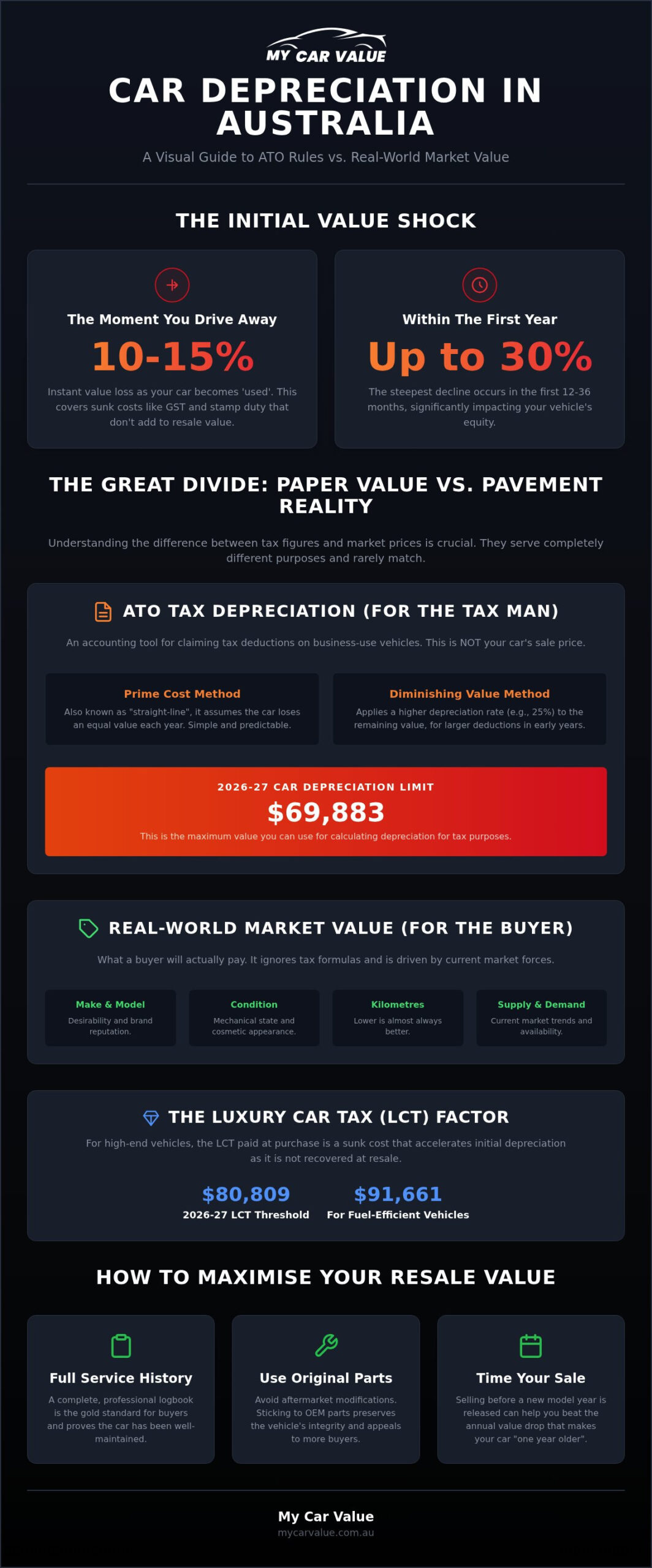
Car depreciation represents the gap between what you paid for your vehicle and what a buyer will pay for it today. It’s the single largest cost of car ownership, often exceeding fuel, insurance, and maintenance combined. In the Australian market, this decline isn’t linear. New cars typically experience their steepest value drop within the first 12 to 36 months. While a car depreciation calculator australia provides a baseline, local factors like the Luxury Car Tax (LCT) can accelerate this loss for high-end vehicles. If your car’s price exceeds the 2026-27 LCT threshold of $80,809, or $91,661 for fuel-efficient models, that initial tax hit is essentially a sunk cost that you won’t recover at resale.
The “Drive-Away” Factor and Initial Loss
The moment those tyres hit the public road, your car transitions from new to used. This shift triggers an immediate value drop of 10% to 15%. This happens because you’ve already paid for GST and on-road costs like stamp duty and registration. These expenses add to your purchase price but don’t add to the vehicle’s market value. By the end of the first year, you might see a total loss of up to 30% of the original sticker price. Understanding this early helps you manage your equity. It also avoids the underwater loan trap where you owe more to the bank than the car is worth on the open market.
Why Depreciation Matters for Your Next Sale
Depreciation dictates your changeover cost. This is the amount of cash you need to bridge the gap between your current car’s sale price and your next vehicle’s purchase price. If you don’t track your car’s value using a car depreciation calculator australia, you risk entering trade-in negotiations with unrealistic expectations. Dealers often use high depreciation rates to justify lower offers. Knowing the real-world figures allows you to negotiate with confidence. You can also bypass the traditional dealership route by connecting with professional Used Car Buyers. This strategy helps you recover more value than a standard trade-in might offer. It turns a theoretical calculation into actual cash in your bank account.
How to Calculate Car Depreciation: ATO vs. Market Value
Tax depreciation is an accounting tool. Market depreciation is a financial reality. While a car depreciation calculator australia helps you track both, they serve entirely different purposes. The Australian Taxation Office (ATO) sets specific rules for business-use vehicles to determine tax deductions. These figures rarely match what a buyer will actually pay you. Understanding the difference prevents you from relying on “paper value” when it’s time to trade in or sell.
The ATO Methods: Prime Cost vs. Diminishing Value
The ATO provides two primary paths for calculating how a vehicle loses value for tax purposes. Both methods require you to know the business-use percentage of your car, typically backed by a valid logbook.
- Prime Cost Method: This is often called straight-line depreciation. It assumes the car loses an equal percentage of its original cost every year over its effective life. It’s simple and provides a predictable deduction.
- Diminishing Value Method: This method applies a higher percentage to the remaining value of the car each year. For 2026, the ATO continues to use a 25% rate for most passenger vehicles. This results in much larger tax deductions in the first few years of ownership.
It’s a common mistake to think a car is worthless once its tax value reaches zero. This “written-down value” is purely for the tax man. A car with a zero-dollar tax value can still fetch a significant sum on the used market. Always consult a registered tax professional to ensure your claims stay within the 2026-27 car depreciation limit of $69,883.
Market Value: The Real-World Reality
Real-world market value ignores fixed accounting formulas. It’s driven by local supply, current demand, and the “desirability” of your specific make and model. While industry benchmarks like Redbook or Glass’s Guide provide a helpful baseline, they can’t always keep up with rapid market shifts. Factors like a car’s colour, its mechanical condition, and even the current price of fuel in Australia will influence the final offer.
To get a clearer picture of your car’s worth, start with a vehicle market value calculator. This provides a data-driven estimate based on current trends rather than rigid tax tables. If you need a firm figure to plan your next purchase, you can Value My Car through our digital platform. This connects you with real-world data and professional buyers, moving you from a theoretical estimate to a bankable result.
Key Factors Influencing Vehicle Depreciation Rates in Australia
While a car depreciation calculator australia provides a baseline, specific local variables dictate your final sale price. Australia’s vast geography means we drive more than many other nations. This high usage directly impacts how buyers perceive value. Beyond the odometer, the market in 2026 is increasingly sensitive to technology shifts and fuel efficiency. Reliable brands like Toyota and Mazda continue to hold value well. However, we are seeing a significant surge in resale prices for hybrids as petrol costs fluctuate. Understanding these drivers helps you predict your car’s future worth more accurately.
The 2026 market also reflects a growing caution regarding older internal combustion engines. As more Australians transition to electric vehicles (EVs) and hybrids, the desirability of traditional petrol cars is shifting. If you own a popular SUV or a fuel-efficient compact, your depreciation curve might be flatter. Conversely, large, thirsty vehicles often see a faster decline in value. The Australian appetite for 4WDs and dual-cab utes remains strong, often defying standard depreciation trends found in other vehicle categories. Tracking these trends ensures you don’t get caught out when it’s time to move on to your next vehicle.
Kilometres and Condition: The Physical Toll
In Australia, the average driver covers about 12,000 to 15,000 kilometres per year. If your odometer exceeds this range, expect a steeper drop in value. Buyers view high mileage as a proxy for upcoming mechanical repairs. It isn’t just about the engine, though. Physical condition matters. Worn tyres, squeaky brakes, or a stained interior can lead to thousands in reconditioning deductions. Professional buyers look for cars that require minimal work to reach a sale-ready state. Keep your interior clean and address minor dings early to protect your equity.
The Role of the Logbook and Service History
A missing logbook is a deal-breaker for many savvy buyers. It can slash your valuation by a significant margin because it removes proof of proper maintenance. In the Australian second-hand market, a full service history is considered gold. While independent mechanics are often excellent, some buyers still prefer the perceived security of dealer servicing for newer models. If you want to maximise your return, ensure every oil change and inspection is stamped and dated. For a deeper dive into what buyers look for, read our car service history check guide to see how to document your car’s life correctly.
Maximising Your Resale Value: A Practical Strategy
Tracking your vehicle’s worth with a car depreciation calculator australia is the first step toward a smarter trade-in. The second step is active value management. To beat the average loss, keep your vehicle as close to factory specifications as possible. While custom wheels or aftermarket exhausts might suit your style, they often narrow your pool of potential buyers. Most professional valuers view modifications as a risk or a cost to reverse. Originality remains the safest path to a higher valuation in the Australian market.
Preparation extends beyond the mechanical. A small investment in professional detailing often returns several times its cost. Buyers make split-second judgements based on first impressions. A clean engine bay, a fresh interior, and a polished exterior suggests the car has been well-maintained. Ensure all dashboard warning lights are cleared and minor cosmetic issues are addressed before seeking a valuation. This level of presentation simplifies the process for buyers and protects your bottom line.
Timing and Market Presentation
Timing is everything when trying to outpace depreciation. The End of Financial Year (EOFY) often sees a flood of new car deals, which can temporarily depress used car prices. It is usually better to sell before this peak or well after it. You should also monitor manufacturer news. Selling your car just before a new model release is critical for a maximum return. Once the latest version hits the showroom floor, your current vehicle becomes “the old model” overnight. This transition triggers an immediate and sharp drop in market desirability.
The PPSR and Transparency
Transparency is your best tool for a fast, fair sale. Every professional buyer will run a PPSR (Personal Property Securities Register) check to see if the car has a financial encumbrance or a history of being written off. Having your own paperwork ready, including rego papers and a clean PPSR report, builds immediate trust. Used car buyers value honesty and speed over a car that appears perfect but has a hidden past. Being upfront about past repairs ensures the transaction moves quickly without last-minute price renegotiations.
Beyond the Calculator: Getting a Real-World Valuation
A car depreciation calculator australia is a vital starting point. It provides a theoretical baseline for your vehicle’s worth based on historical data. However, an algorithm cannot inspect your car’s paintwork or hear the engine run. A professional offer is a firm commitment to buy. A calculator is merely an educated guess. Moving from “calculating” to “valuing” is how you turn a digital figure into actual cash. It is the difference between knowing what your car might be worth and knowing what you will actually receive.
Why a Professional Valuation Beats a DIY Estimate
Professionals look for factors that a standard algorithm might miss. A calculator often fails to account for the high demand of a specific limited-edition trim or the value of a factory-fitted safety pack. Sometimes, specific models defy standard depreciation curves because of sudden supply shortages or shifting consumer tastes in 2026. The Value My Car service provides the most accurate way to find your car’s true worth. It bridges the gap between general market data and the specific condition of your vehicle. Expert valuers consider the local market appetite. This can vary significantly across the country, affecting your final price in ways a simple tool cannot predict.
The Streamlined Path to Selling Your Car
The My Car Value process strips away the stress of private sales. You don’t have to deal with tyre-kickers who waste your weekends. There is no need to pay for expensive private ads or manage endless enquiries. We use a data-driven approach to connect you with professional Used Car Buyers who are ready to act. Our platform acts as a savvy intermediary. We do the heavy lifting for you. The process is methodical and fast:
- Enter your vehicle details through our digital platform.
- Receive a realistic market valuation based on current Australian data.
- Connect with professional buyers from our national network.
- Finalise the sale and receive instant payment.
This network reaches across Australia. It ensures you get a competitive offer regardless of your location. We have simplified a legacy system that was once confusing and time-consuming. You gain transparency and speed. This approach creates a sense of relief. You avoid the uncertainty of the open market and the risk of lowball offers from opportunistic private buyers. It is the most efficient way to close the chapter on your current car and move to the next one with confidence.
Take Control of Your Vehicle’s Future Value
Understanding car depreciation is the difference between a stressful trade-in and a confident financial move. A car depreciation calculator australia provides a vital mathematical baseline, but your actual return depends on real-world market demand and vehicle presentation. You don’t have to guess your car’s worth when you can access data-driven insights. By maintaining a complete service history and timing your sale correctly, you protect your equity against the steep losses typical of the first few years.
Moving beyond theoretical numbers requires a direct connection to the marketplace. You can bypass the frustration of private classifieds and avoid the uncertainty of unreliable buyers by accessing transparent, market-based valuations. Our platform links you with a national network of professional buyers who understand the true worth of your vehicle in the current Australian climate.
Start your next car journey with clarity and confidence. You now have the tools to turn depreciation from a hidden cost into a managed asset.
Frequently Asked Questions
How much does a new car depreciate in the first year in Australia?
New cars in Australia typically lose between 10% and 15% of their value the moment they leave the dealership. By the end of the first year, total depreciation often reaches 25% to 30%. This initial drop includes the loss of GST and on-road costs like stamp duty. Using a car depreciation calculator australia helps you visualise this steep decline. Tracking these figures early allows you to manage your equity and avoid owing more than the vehicle is worth.
Does the ATO car depreciation calculator apply to private use vehicles?
No, the ATO car depreciation rules do not apply to vehicles used purely for private purposes. Tax depreciation is only available for cars used to produce assessable income. If you use your car for both, you can only claim the business portion. For private owners, depreciation is a market reality rather than a tax deduction. You should focus on market value trends to understand your vehicle’s current resale potential instead of tax tables.
Which car brands in Australia have the best resale value?
Brands like Toyota, Mazda, and Honda consistently hold the best resale value in the Australian market. Their reputation for reliability and the widespread availability of parts make them highly desirable for second-hand buyers. In 2026, we are also seeing strong retention for hybrid models from these manufacturers. Popular SUVs and dual-cab utes often depreciate slower than luxury sedans because they cater to a much larger segment of the local used car market.
How do I calculate depreciation for my business car for tax purposes?
You calculate business depreciation using either the Prime Cost or Diminishing Value method. For the 2026-27 financial year, the car depreciation limit is $69,883. The Diminishing Value method uses a 25% rate for most cars, providing higher deductions in the early years. You must keep a valid logbook to prove your business-use percentage. Always consult a registered tax agent to ensure your calculations align with the latest Australian Taxation Office requirements and regulations.
Does high mileage always mean a car has depreciated more?
High mileage usually indicates higher depreciation, but it isn’t the only factor. A car with 150,000 kilometres and a perfect service history can be worth more than a car with 80,000 kilometres that has missed its logbook stamps. Buyers prioritise mechanical certainty. If your high-mileage vehicle is in excellent physical condition and has recently had major components replaced, it may defy the standard depreciation curves found in a generic car depreciation calculator australia.
Can I stop my car from depreciating?
You cannot stop a standard passenger vehicle from depreciating, but you can significantly slow the process. Focus on three main areas: maintaining a full service history, keeping the kilometres near the Australian average of 12,000 per year, and avoiding permanent modifications. Storing the car in a garage to protect the paint and keeping the interior immaculate also helps. While the car will still lose value, these steps ensure you stay at the top of the market range.
What is the difference between Redbook value and market value?
Redbook provides a data-driven benchmark based on historical sales and specifications. It is an industry standard for insurance and finance companies. Market value is the actual price a buyer is willing to pay in the current environment. While Redbook offers a reliable guide, it cannot always account for sudden shifts in supply or specific local demand. A professional valuation considers the real-world condition of your car, providing a more accurate figure than a static data point.