

Car History: Why Transparency Maximises Your Vehicle’s Value in 2026
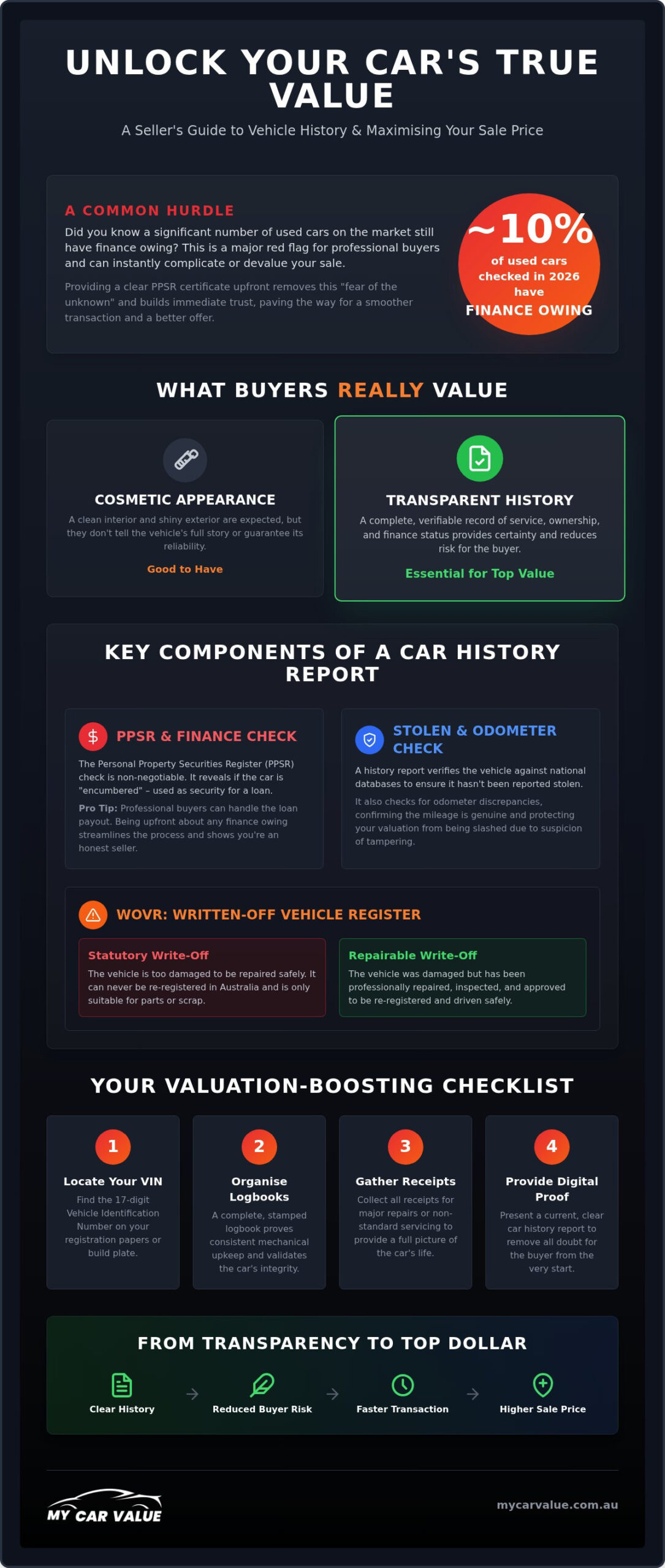
Did you know that nearly 10% of used cars checked in 2026 still have finance owing on them? It’s a statistic that makes professional buyers cautious, but it shouldn’t make you anxious. Selling your vehicle often feels like a high-stakes game where you’re worried a minor past incident or a confusing car history report might tank your valuation. You want a fair price without the stress of defending every scratch or PPSR entry.
We understand that the process can feel opaque and weighted against the seller. That’s why we’re showing you how to turn transparency into your biggest competitive advantage. By the end of this article, you’ll know exactly how to use a clear history to maximise your final sale price and secure a better deal from professional buyers.
We’ll demystify PPSR and WOVR terminology so you can speak the same language as the experts. You’ll also learn the most efficient way to present your vehicle’s past to ensure a smooth, honest transaction that leaves no money on the table.
Key Takeaways
- Professional buyers in 2026 prioritise a transparent car history over cosmetic appearance to determine a vehicle’s true market worth.
- Understand how PPSR and WOVR records impact your bottom line and how to address encumbrance before listing your vehicle.
- Organise your VIN, logbooks, and service receipts to provide the digital and physical proof required for a premium valuation.
- Use a clear history report to protect your resale price and ensure a seamless transaction with professional used car buyers.
Understanding Car History: The Foundation of Vehicle Value
Your car history is the complete life story of your vehicle. It is a dual record consisting of digital data stored in government databases and the physical evidence found in your glovebox. While many sellers focus on a fresh wax or a detailed interior, professional buyers in 2026 look straight at the data. They prioritise a documented past over a shiny exterior because a car’s history provides a reliable forecast of its future performance and re-sellability.
There is a significant difference between a basic registration check and a comprehensive history report. A rego check merely confirms the vehicle is legal to drive today. In contrast, Vehicle history reports provide a deep dive into previous ownership, odometer readings, and insurance claims. For a professional buyer, a clean report reduces the “risk premium” they typically build into a quote. When you provide total transparency, you remove the need for them to hedge their bets with a lower offer to cover potential hidden issues.
Why Transparency Matters to Professional Buyers
Professional buyers operate on thin margins and high volume. They need low-risk stock that they can move quickly. If a car history is murky or incomplete, it creates a “fear of the unknown” that slows down the transaction. Transparency allows these buyers to make faster, firmer price commitments. When every service interval is logged and the PPSR status is clear, the buyer can skip the guesswork and offer you a price based on the vehicle’s actual merit rather than a worst-case scenario. This clarity is especially vital in a buyer’s market where stock levels are high and competition for premium, well-documented vehicles is fierce.
The Link Between History and Market Value
Modern valuations are almost entirely data-driven. When you use a vehicle market value calculator, the software relies on historical accuracy to generate a figure. A vehicle with a fragmented service history or an undisclosed repair record will naturally fall into a lower valuation bracket. Conversely, a documented past justifies a top-tier market price.
To maximise your return, you must prove your car belongs in the top 10% of available stock. You can achieve this by highlighting specific historical markers:
- Consistent Service Intervals: Proves the mechanical integrity of the engine and drivetrain.
- Clear PPSR Status: Confirms there is no “finance owing” that could complicate the title transfer.
- Odometer Consistency: Validates that the mileage is genuine and hasn’t been tampered with.
By presenting this information upfront, you position yourself as a savvy seller. You aren’t just selling a car; you’re selling certainty. This professional approach is the most effective way to ensure your final sale price reflects the true worth of your asset.
Key Components of an Australian Car History Report
A comprehensive car history report is your most persuasive sales tool. It aggregates data from multiple government agencies to provide a definitive profile of your vehicle. In 2026, professional buyers won’t just take your word for it. They’ll verify every detail against the Personal Property Securities Register (PPSR) and the Written-off Vehicles Register (WOVR). This digital audit is the only way to prove your car is a low-risk asset.
Beyond finance and accidents, a report includes a stolen vehicle check and odometer verification. If your digital service records show 80,000km but the dash says 60,000km, the valuation will drop instantly. Accuracy is paramount. Ensuring these records align before you list the vehicle prevents awkward negotiations later. It also protects you from being associated with the small percentage of sellers who attempt to mask a vehicle’s true mileage.
Decoding the PPSR and Finance Owing
If your report shows the car is “encumbered,” it simply means there is a registered security interest against it, usually a car loan. This is common. Data from 2026 shows approximately 9.9% of used cars undergoing history checks have finance owing. Don’t let this stall your sale. Professional sell my car services are designed to handle this. Most buyers will pay out your remaining balance directly to the lender and transfer the surplus to you. Clearing this up early streamlines the entire transaction and removes a major hurdle for the buyer.
The WOVR: Repairable vs. Statutory Write-offs
The WOVR distinguishes between two critical categories. A statutory write-off is a vehicle so heavily damaged it can never be registered again. It’s destined for the scrap heap or parts. A repairable write-off, however, can be fixed and re-registered after a formal inspection. While 13.4% of suspicious vehicles checked have a write-off record, many are simply “hail damage” markers. These are common in Australia and don’t necessarily mean the car is unsafe. However, they do impact the resale price significantly. Disclosing this upfront builds trust and helps you find buyers who specialise in these types of vehicles.
If you aren’t sure what your report currently says, you can check your market value to see how these factors influence current professional offers. This proactive step ensures you aren’t surprised by a lower valuation during the final inspection.
The Impact of a “Dirty” History on Your Resale Price
A “dirty” car history is more than a minor setback; it is a direct financial penalty. Professional buyers use data to quantify risk. If that data is missing or negative, they protect their margins by lowering their offer. In the current Australian market, a lack of documented service history alone can lead to a 10-20% reduction in the final quote. Buyers view a missing logbook as a sign of potential mechanical neglect, and they price the vehicle accordingly.
Grey imports also face steeper depreciation in Australia. Because these vehicles often lack local compliance data and parts availability can be uncertain, buyers apply a significant discount to compensate for the higher resale risk. Similarly, the “Finance Trap” remains the fastest way to kill a sale. Undisclosed debt doesn’t just lower the price; it usually cancels the transaction instantly. Professional buyers cannot legally take clear title of an encumbered vehicle without a verified payout. Always disclose your balance early to keep the deal moving.
Odometer Discrepancies: The Ultimate Trust Breaker
Professional buyers cross-reference your dashboard with the National Exchange of Vehicle and Driver Information System (NEVDIS). This database tracks mileage at every registration and transfer point. If they spot a discrepancy, it suggests “clocking,” which is a serious legal issue and an immediate deal-breaker. If you find an error in your records, you should perform a car service history check to identify where the data diverged. Correcting these genuine clerical errors before a professional inspection is the only way to salvage your vehicle’s value.
Previous Accident Damage and Resale
Buyers distinguish between minor “bingle” repairs and structural chassis damage. A bumper respray for a supermarket scratch is generally negligible. However, previous structural repairs flagged on an official car history report suggest the vehicle’s integrity might be compromised. Buyers assess the quality of these repairs meticulously. Being upfront about past damage allows you to provide receipts for high-quality repairs. This transparency helps maintain a firmer price than if the buyer discovers the damage themselves during a physical inspection.
How to Organise Your Vehicle History for a Better Valuation
Professional buyers work fast. To secure a top-tier offer, you need to match their pace. Organising your documentation before the inspection proves you’ve maintained the asset properly. It removes the friction that often leads to price chipping during negotiations. When you present a complete car history, you’re demonstrating that there are no hidden costs or maintenance debts waiting for the next owner.
Efficiency is the key to a successful sale in 2026. Buyers prefer a seller who has already done the heavy lifting. By following a methodical approach to your paperwork, you can transition from a verbal quote to a firm bank transfer in record time. Start by creating a digital folder on your phone or computer. Scan your receipts and logbook pages so you can share them instantly with professional buyers during the initial valuation phase.
Gathering the Paperwork
The original logbook is the most valuable item in your glovebox. It serves as the physical proof of your vehicle’s maintenance journey. If your logbook is missing entries, don’t panic. Contact the service centres where you’ve had work performed. Most modern workshops keep digital backups and can provide duplicate stamped records or a printed service summary. You’ll also need to locate your VIN (Vehicle Identification Number). This 17-digit code is your car’s digital fingerprint. It allows buyers to verify the exact build date and factory specifications, ensuring they aren’t valuing a base model when you actually own a premium variant.
The Pre-Sale PPSR Check
Smart sellers run their own checks before listing. As of August 2026, a standard online search of the Personal Property Securities Register (PPSR) costs just $2.00. This is a small price for total certainty. When you have this certificate ready, you can prove your car is clear of any financial interest or “encumbrance.” If a bank still has a recorded interest from a loan you’ve already paid off, you can contact them to have it removed before the buyer sees it. This prevents a “finance owing” flag from scaring off a professional buyer or delaying your final payout. Dealing with these administrative hurdles early keeps you in control of the timeline.
Get a professional valuation in Sydney
- Step 1: Locate your VIN and Chassis number on the compliance plate for accurate data matching.
- Step 2: Gather all physical logbooks and ensure service receipts are in chronological order.
- Step 3: Conduct a pre-sale PPSR check to confirm no surprises exist on the national register.
- Step 4: Prepare a digital folder of your documents for instant professional review.
Get an Accurate Market Valuation with My Car Value
You’ve organised your receipts, verified your VIN, and confirmed your PPSR status. Now you need a valuation that reflects the true worth of your well-documented vehicle. My Car Value isn’t just another generic price estimator. Our platform integrates your car history data to provide realistic market offers that reward transparency. We bridge the gap between a basic “book value” and the premium price your maintained vehicle actually deserves.
Our digital platform streamlines the entire verification process. Instead of spending hours explaining your car’s past to multiple people, you enter your details once. We use that data to connect you with used car buyers who specifically look for high-quality, transparent stock. This modern approach removes the guesswork and ensures that your final offer is based on facts, not just a quick visual inspection. We provide the tools you need to sell with total confidence.
Why Our Network Prefers Documented Histories
The professional buyers in our network are looking for quality stock they can stand behind. They value a documented car history because it eliminates the risk of hidden mechanical failures or financial encumbrances. When you provide a transparent record, you’re essentially offering a guarantee of quality. This leads to significantly faster inspections. Because the buyer already trusts the data provided through our platform, they can move straight to a firm offer and an immediate payout. You aren’t just selling a car; you’re providing a low-risk business opportunity for the buyer, which justifies a more competitive price.
Start Your Valuation Today
The My Car Value promise is simple: no stress, no private sale tyre-kickers, and no low-ball offers based on incomplete data. We’ve removed the friction from the traditional selling process to save you time. Our methodical system ensures that every service stamp and clear PPSR certificate works in your favour. Transparency is the quickest route to a sold sticker in the 2026 market. Don’t leave your resale price to chance or settle for a quote that ignores your vehicle’s excellent maintenance record.
- Enter your vehicle details and VIN for an instant start.
- Upload your digital history folder for a more accurate professional assessment.
- Receive a competitive market offer based on your car’s specific merits.
- Complete the sale with a professional buyer who values your transparency.
Value your car with confidence today. Experience a faster, fairer way to sell your vehicle by putting your car’s history front and centre.
Secure Your Vehicle’s Future Value Today
Transparency is no longer just a courtesy; it’s a strategic financial decision. By presenting a comprehensive car history, you remove the risks that typically lead to lower offers. You’ve seen how to decode PPSR status, address WOVR markers, and organise your digital records to prove your vehicle’s worth. These steps ensure you don’t leave money on the table during negotiations.
My Car Value provides fast, transparent, and data-driven valuations that reflect the current market. We’ve helped thousands of Australian sellers skip the stress of private listings and tyre-kickers. Our platform offers direct access to professional used car buyers who are ready to reward your honesty with a competitive price. It’s the most efficient path to a successful sale.
Take control of your car’s story and turn your maintenance records into a higher payout. You’ve done the work to look after your vehicle; now let the data prove it.
Frequently Asked Questions
What exactly shows up on an Australian car history report?
An official report aggregates data from several different government registers to provide a complete profile. It includes the Personal Property Securities Register (PPSR) status to check for debt and the Written-off Vehicles Register (WOVR) for accident history. You will also see stolen status from national police records, odometer readings from previous sales, and registration history across different Australian states to verify the vehicle’s legal standing.
Can I sell my car if the history report shows finance is still owing?
Yes, you can sell an encumbered vehicle to professional buyers without any issues. They typically calculate the exact payout amount with your lender and settle the debt on your behalf as part of the transaction. Any remaining equity is then paid directly into your bank account. This process ensures the buyer receives a clear title while you avoid the legal complexity of managing the finance transfer yourself.
How much does a PPSR check cost in Australia in 2026?
A standard online PPSR search currently costs $2.00 as of August 2026. This fee is set by the Australian government for searches conducted through the official online portal. If you require an assisted search via a contact centre, the cost increases to $7.00. Many third-party providers also offer comprehensive car history reports for between $7 and $40, which often include additional data like odometer verification and market valuations.
Will a minor accident on my car’s history significantly lower its value?
Minor cosmetic repairs usually have a negligible impact on your car’s value if you provide the repair receipts. Professional buyers distinguish between surface-level “bingle” repairs and structural damage. However, if an accident resulted in a repairable write-off marker on the WOVR, expect a significant reduction in the final offer. Disclosing high-quality repair documentation helps maintain buyer confidence and protects your price from unnecessary discounting during the physical inspection.
What is the difference between a VIN and a chassis number?
A VIN (Vehicle Identification Number) is a 17-character unique code used for all modern vehicles since 1989. It provides a global standard for tracking a car history and factory specifications. A chassis number is a shorter serial number stamped directly onto the vehicle’s frame by the manufacturer. While they are often used interchangeably for older cars, the VIN is the primary data point for all current digital history checks and government registers.
How do I find out if a car has been written off previously?
You can identify previous write-offs by conducting a PPSR search, which includes a section for the Written-off Vehicles Register (WOVR). This register categorises damage as either “statutory” or “repairable.” A statutory write-off can never be re-registered in Australia and is only suitable for parts. A repairable write-off can return to the road after passing a rigorous safety inspection, though it will carry a permanent marker on its digital record forever.
Does a missing service logbook affect the professional valuation?
A missing logbook can lead to a 10% to 20% reduction in professional offers. Buyers view the logbook as essential proof of mechanical maintenance and consistent care. Without it, they must assume the worst regarding the engine’s health and upcoming service requirements. If your book is lost, contact your previous mechanics to request duplicate receipts or a printed service summary. This evidence helps restore your vehicle’s value and justifies a higher price.
Can a car history report show if the odometer has been tampered with?
A history report identifies odometer tampering by highlighting discrepancies between historical readings recorded over time. It cross-references mileage data captured during registration renewals, ownership transfers, and previous sales. If a recent reading is lower than an earlier entry, it triggers a warning for “clocking.” This data allows professional buyers to verify the integrity of the dash display before making a firm commitment to purchase your vehicle at market value.