

What is a WOVR Check? The 2026 Australian Guide to Written-Off Vehicles
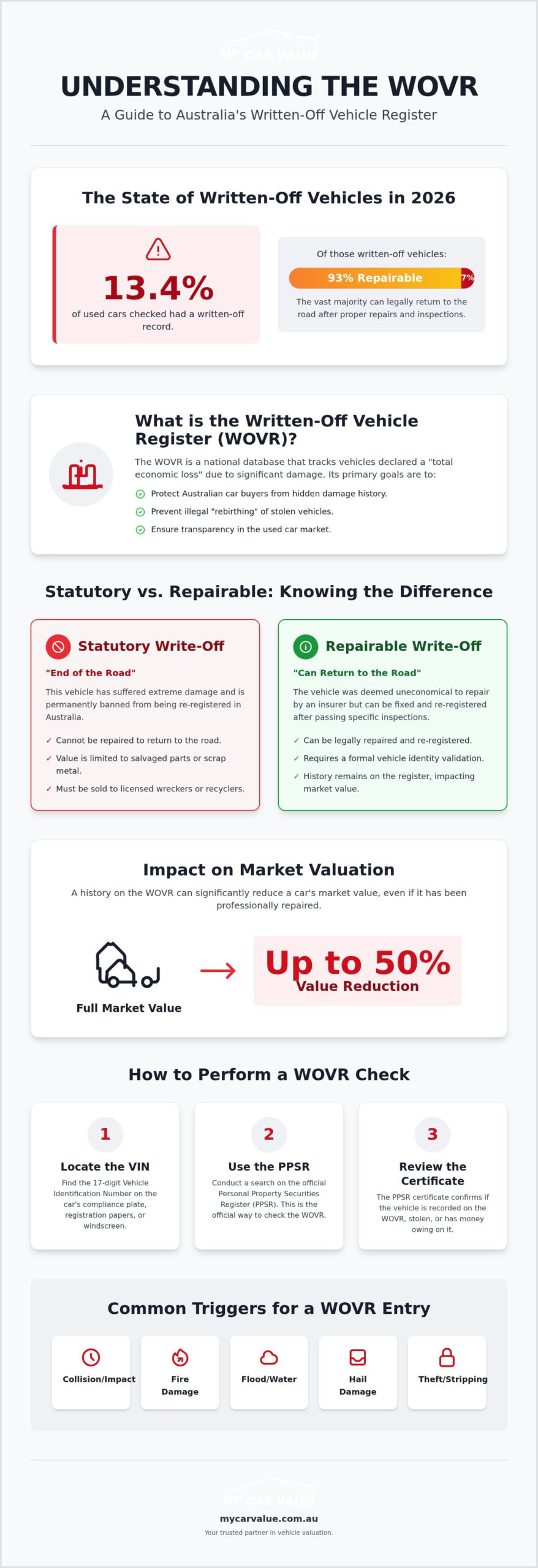
Did you know that 13.4 per cent of used cars checked in 2026 carried a written-off record? It is a staggering figure that highlights why a wovr check is no longer optional for savvy Australian buyers and sellers. While many assume a write-off means a car is destined for the scrap heap, 93 per cent of these records are actually for repairable write-offs that can legally return to the road.
You are right to feel cautious. Whether you are buying or selling, the uncertainty surrounding a vehicle’s history can make the process feel stressful and complex. You need to know if a car is safe, legal, and priced correctly for its condition. No one wants to be caught out by a hidden history or an unfair valuation.
This guide explains exactly how the Written-Off Vehicle Register impacts your car’s market value and how to navigate the selling process with total transparency. We will break down the differences between statutory and repairable statuses, outline current 2026 inspection requirements, and provide a clear path to determining a fair price for your vehicle.
Key Takeaways
- Understand how the national database tracks total economic losses to prevent illegal vehicle rebirthing and protect Australian car buyers.
- Learn the critical distinction between statutory and repairable write-offs to determine if a vehicle can ever be legally re-registered.
- Discover why a history on the register can slash market value by up to 50 per cent and how to find an accurate price for your car.
- Use a 17-digit VIN to perform a wovr check through the official PPSR and confirm a vehicle’s status before you buy or sell.
- Identify the most efficient exit strategy for a car with a history, from meeting legal disclosure rules to finding professional buyers.
Understanding the Written-Off Vehicle Register (WOVR)
The Written-Off Vehicle Register (WOVR) is a national database that tracks every motor vehicle declared a “total economic loss”. Managed by state road authorities, it serves as a central record for cars, motorcycles, and trucks that have sustained significant damage. This register functions as a vital tool for transparency in the Australian used car market. It ensures that a vehicle’s history is visible to any interested party, preventing hidden surprises during a transaction.
The system exists primarily to protect consumers and maintain road safety. One of its most important roles is preventing “rebirthing”. This is a criminal practice where the Vehicle Identification Number (VIN) from a wrecked car is placed onto a stolen vehicle of the same model to hide its origin. By maintaining a strict record of write-offs, the register makes it difficult for stolen cars to be re-entered into the system of vehicle registration in Australia. It creates a digital paper trail that follows the chassis for its entire lifespan.
Finding this information is quick and efficient. In 2026, you don’t browse the register directly; instead, you perform a wovr check via a Personal Property Securities Register (PPSR) search. This process delivers a comprehensive certificate showing if the car is stolen, has money owing, or is recorded as a write-off. Whether you are evaluating a car in Sydney or checking a local listing online, this step is non-negotiable. It provides the data needed to make an informed, confident decision before any money changes hands.
Who decides a car is a write-off?
Insurance companies act as the primary notifiers for the register. When a vehicle is involved in an accident or incident, a loss adjuster assesses the damage against the car’s current market value. If the repair costs are too high, they declare it a “total economic loss”. This isn’t just for private cars. Self-insured fleet operators and auction houses also contribute data to the system. This collective reporting ensures that any vehicle deemed uneconomical to repair is flagged immediately.
What triggers a WOVR entry?
Several specific types of damage will trigger an entry on the register. Major structural damage is the most common, covering issues like chassis misalignment or severe impact from collisions and rollovers. Environmental events also play a significant role. Vehicles damaged by fire, flood, or heavy hail are frequently added to the list in 2026 due to rising repair complexities. Malicious damage or stripped parts after a theft can also lead to a write-off declaration. If the cost to restore the vehicle to a safe condition exceeds its value, a wovr check will reflect that history.
Statutory vs Repairable Write-Offs: Knowing the Difference
Understanding the distinction between these two categories is essential for any Australian car owner. It dictates whether a vehicle can ever legally return to the road or if it must be dismantled for parts. A standard wovr check will clearly identify which label has been applied to the chassis. Transparency is key here. You must disclose this status to potential buyers to avoid legal complications and maintain trust during a sale.
The classification process is rigorous. When an insurer assesses a claim, they weigh the cost of repairs against the vehicle’s market value. However, safety remains the priority. Even if a car is technically repairable, severe structural compromises will force a statutory classification to keep dangerous vehicles off the street. For sellers, knowing where your car sits is the first step in determining a realistic exit strategy.
Statutory Write-Offs: End of the Road
Statutory write-offs represent the absolute end of a vehicle’s life as a registered mode of transport. These cars have suffered extreme damage, such as heavy fire, total flood immersion, or major structural collision impact. Under the national rules for Statutory vs Repairable Write-Offs, these vehicles are permanently banned from being registered again in Australia. You cannot fix them and put them back on the road, regardless of how much money you spend.
Financial recovery for these vehicles is limited. Valuation is strictly tied to the value of salvaged parts or scrap metal. Because they cannot be driven, they are usually sold to licensed wreckers or scrap metal merchants. If your wovr check reveals a statutory status, don’t attempt to sell it as a used car. It is a “parts only” asset. Focus on finding a reputable buyer who specialises in end-of-life vehicle recycling to recoup what value remains.
Repairable Write-Offs: A Second Life
Repairable write-offs offer a different path. These vehicles are declared a total loss because the repairs are too expensive for the insurer, not necessarily because the car is unsafe. In fact, 2026 data shows that 93 per cent of recorded write-offs fall into this category. These cars can return to the road, but the process is strict. They must pass rigorous safety and identity inspections, such as a Vehicle Identity Validation (VIV) test, before they can be re-registered.
While these vehicles can be legally driven again, their history remains on the register forever. This record impacts the price. Professional used car buyers often specialise in these refurbishments because they understand the technical requirements for re-entry. If you are trying to sell a car with this history, you need an accurate assessment of its worth. You can Value My Car to get a realistic market price that accounts for its specific WOVR record, ensuring you don’t undersell or mislead potential buyers.
How a WOVR Status Impacts Your Car’s Market Valuation
A WOVR record acts as a financial anchor. It can slash a car’s market value by 20 per cent to 50 per cent compared to an identical model with a clean title. Standard valuation tools like Redbook often fail to account for this specific history. They provide a baseline for vehicles in good condition, but they don’t adjust for the permanent mark on the national register. This creates a significant gap between expectation and reality for many sellers.
Buyers perceive a much higher level of risk when a car has a history of being written off. This perception leads to lower offers and significantly longer selling times. Even if the repairs were performed to the highest standard, the mere presence of the record suggests potential hidden issues. Performing a wovr check provides the evidence you need to understand your car’s standing in the current market. Without this data, you are essentially guessing your car’s worth.
Transparency is your best tool for maintaining value. Before setting a price, visit the official PPSR website to Perform a WOVR Check. This search reveals the specific damage codes that triggered the write-off. Being able to explain exactly why the car was listed, such as minor hail damage versus a major structural collision, allows you to justify your asking price to a serious buyer.
The “Stigma” Factor in Private Sales
Private buyers are notoriously risk-averse. Any mention of a write-off history often sends them looking for the next listing. This isn’t always about the mechanical state of the car. Insurance premiums for previously written-off vehicles are frequently higher, which adds to the long-term cost of ownership. Additionally, many Australian lenders refuse to provide financing for cars with a repairable history. This effectively limits your pool of potential buyers to those with cash on hand who are willing to accept the “stigma” for a lower entry price.
Setting a Realistic Price in 2026
Pricing a repairable write-off requires a methodical approach. Start by researching similar “repairable” listings on classified sites to gauge the current market floor. You must also account for the cost of inspections and safety certifications required for re-registration. To establish a solid starting point, use a vehicle market value calculator to find a clean-title baseline. From there, apply a realistic discount based on the specific damage recorded in your wovr check.
Professional valuations are essential to set a realistic expectation. Selling a car with a history takes patience and often involves aggressive haggling. If you are in Perth or another major metropolitan area, professional used car buyers are often the most reliable exit strategy. They value the car based on its actual mechanical condition and market demand rather than emotional “stigma”, providing a faster and more certain transaction.
How to Perform a WOVR Check Using Your VIN
Locate your 17-digit Vehicle Identification Number (VIN) before you begin. This unique identifier is the only way to ensure the data you receive belongs to the specific chassis you are investigating. You can find the VIN stamped on the compliance plate under the bonnet, on the passenger side door pillar, or listed clearly on your rego papers. Accuracy is vital. A single mistyped character will result in an invalid search or, worse, data for the wrong vehicle.
Once you have the VIN, visit the official PPSR website to conduct a national search. In 2026, the government fee for this service is $2.00. This nominal cost provides a real-time certificate that is legally recognised across Australia. Avoid third-party websites that often charge significantly more for the same information. The official search is fast, impartial, and provides the most up-to-date records available from state road authorities.
Open the generated PDF and scroll to the “Written-off” section. If the vehicle has a clean history, this area will be blank. If a record exists, it will list the date of the incident and the state where it occurred. This is the core of your wovr check. It provides the evidence you need to either proceed with a purchase or walk away from a bad deal. Having this document on hand also helps when you need to justify a lower offer to a seller.
Decoding the Damage Codes
Reports use specific codes to describe the reason for a write-off. “Impact” refers to collision damage, while “Hail” indicates environmental trauma. “Water” usually signifies flood immersion, which can lead to long-term electrical failures. Performing a wovr check allows you to see the “Severity” rating associated with these codes. A “light” rating might suggest cosmetic damage, whereas “heavy” indicates structural compromise. Always verify the entry date against the car’s logbook to see if repairs were officially recorded.
Why a VIN Check is Better than a Plate Search
Plates can be changed, swapped between states, or even stolen. The VIN is the permanent DNA of the vehicle. A VIN-based search tracks the car’s entire history across every Australian state and territory, ensuring no records are missed if the car has moved across borders. For a complete picture of a vehicle’s health, combine your search with car service history checks. This ensures the maintenance records align with the official register data.
Selling a Vehicle with a WOVR History in Australia
Selling a car with a history requires a pragmatic approach. Full disclosure isn’t just a legal requirement in most Australian states; it’s a way to filter for serious buyers. Failing to mention a write-off status can lead to severe penalties or a cancelled sale later in the process. Transparency builds immediate trust. If a buyer performs their own wovr check and discovers a hidden history you didn’t mention, the deal will collapse instantly. Being upfront allows you to control the conversation and focus on the quality of the repairs.
Prepare your documentation before you list the vehicle. Gather every repair receipt, parts invoice, and official inspection certificate. If the car has passed a Vehicle Identity Validation (VIV) or similar state-based safety check, keep that paperwork ready for inspection. These documents prove the car is safe and roadworthy, helping to counter the “stigma” associated with write-offs. A well-documented repairable write-off is far easier to sell than one with a mysterious or undocumented past.
Avoid the frustration of private classifieds if you want a fast result. Vehicles with a WOVR record often languish on social marketplaces for weeks. You will likely encounter “tyre-kickers” who use the car’s history as an excuse for low-ball offers without even inspecting the vehicle. This process is time-consuming and rarely yields the best financial outcome. Instead, focus on buyers who understand the technical value of a refurbished vehicle.
Connecting with Professional Buyers
Professional used car buyers are often the most efficient route for complex sales. These buyers understand the value of a well-repaired write-off and look past the initial record to the car’s actual condition. They offer a streamlined process that bypasses the emotional hurdles found in the private market. Whether you are in Brisbane or elsewhere, these professionals provide a firm offer based on data and mechanical integrity, ensuring a much faster transaction.
Maximising Your Return via My Car Value
Our platform helps you sell my car by connecting you to a network that specialises in accurate valuations. We provide a clear price that reflects the reality of the 2026 Australian market, taking the guesswork out of your car’s worth. Don’t rely on generic tools that ignore the specifics of a wovr check history. We help you find the right exit strategy for your vehicle, regardless of its previous status.
Move forward with clarity. Whether you are buying or selling, having the right data ensures you make the best decision for your hip pocket and your peace of mind. Take the guesswork out of the process and secure a fair deal today.
Common Questions About Written-Off Vehicles
Can I register a car that has a statutory write-off status?
No, you cannot register a statutory write-off in Australia. These vehicles are deemed too damaged for safe repair and are classified for “parts only” or scrap metal. Once this label is applied to the chassis, the car is permanently banned from returning to any Australian road.
Is a repairable write-off safe to drive?
Yes, a repairable write-off is safe to drive once it has passed a rigorous state-based safety and identity inspection. These tests ensure the vehicle has been restored to manufacturer standards. Always check the repair documentation and safety certificates to verify the quality of the work performed before you buy.
How much does a wovr check cost in 2026?
The official government fee for a PPSR search, which includes a wovr check, is $2.00 in 2026. This provides a real-time certificate directly from the national database. Avoid commercial sites that may charge significantly higher fees for the same basic information.
Does a wovr check show if a car has been stolen?
Yes, the report generated by a wovr check includes a specific section for stolen vehicle status. It cross-references national police records to confirm if there is an active report against the VIN. This is a critical step for avoiding illegal transactions and protecting your investment.
Will insurance be more expensive for a car on the WOVR?
Insurance premiums are typically higher for vehicles with a write-off history. Some insurers may also refuse comprehensive cover, offering only third-party property damage instead. It is wise to get several quotes before finalising the purchase of a repairable write-off to understand your ongoing costs.
How do I remove a car from the Written-Off Vehicle Register?
You cannot remove a vehicle from the register. The WOVR status is a permanent record tied to the VIN for the life of the vehicle. Even after a repairable write-off is fixed and re-registered, the original entry remains on the database to ensure total transparency for future owners.
What is the difference between a PPSR check and a WOVR check?
A PPSR search is the complete report, while the WOVR is a specific section within that report. The PPSR covers financial interests and stolen status, whereas the WOVR focuses exclusively on the vehicle’s damage and total loss history recorded by insurance companies and road authorities.
Can I sell a WOVR car to a dealership?
Yes, you can sell a repairable write-off to a dealership, but expect a significantly lower trade-in offer. Most dealers will reduce the price by 20 per cent to 50 per cent to account for the added difficulty in reselling a car with a recorded history on the register.