
Value Your Vehicle: The Ultimate 2026 Australian Seller’s Checklist
In the 2026 Australian market, your car’s service history is often worth more than its shiny paint job. It’s a struggle to accurately value your vehicle when Redbook estimates clash with real-world market prices and the sudden influx of affordable new models. You’ve likely felt the stress of preparing for a professional inspection, fearing you’ll be lowballed because of a missing logbook entry or a minor cosmetic flaw. It’s a common frustration, but it doesn’t have to be your experience.
We believe selling your car should be transparent and fast, not a battle of wits. This guide provides a comprehensive checklist to help you master the car valuation process and secure the best possible price from professional buyers. We’ll show you how to document your car’s provenance and handle inspections with total authority. By following these logical steps, you’ll replace confusion with confidence and ensure a seamless, professional sale that respects your time and your car’s true worth.
Key Takeaways
- Distinguish between static Redbook estimates and real-world market value to set a realistic price in the 2026 economy.
- Organise your logbook and PPSR certificate to prove your car’s provenance and eliminate buyer doubt instantly.
- Follow a systematic approach to value your vehicle using current market data rather than outdated online calculators.
- Apply the ‘First 60 Seconds’ rule to prepare your car’s exterior and interior for a successful professional inspection.
- Identify the mechanical red flags that professional buyers look for to avoid unexpected price reductions during the sale.
Defining Market Value: What Is Your Vehicle Actually Worth in 2026?
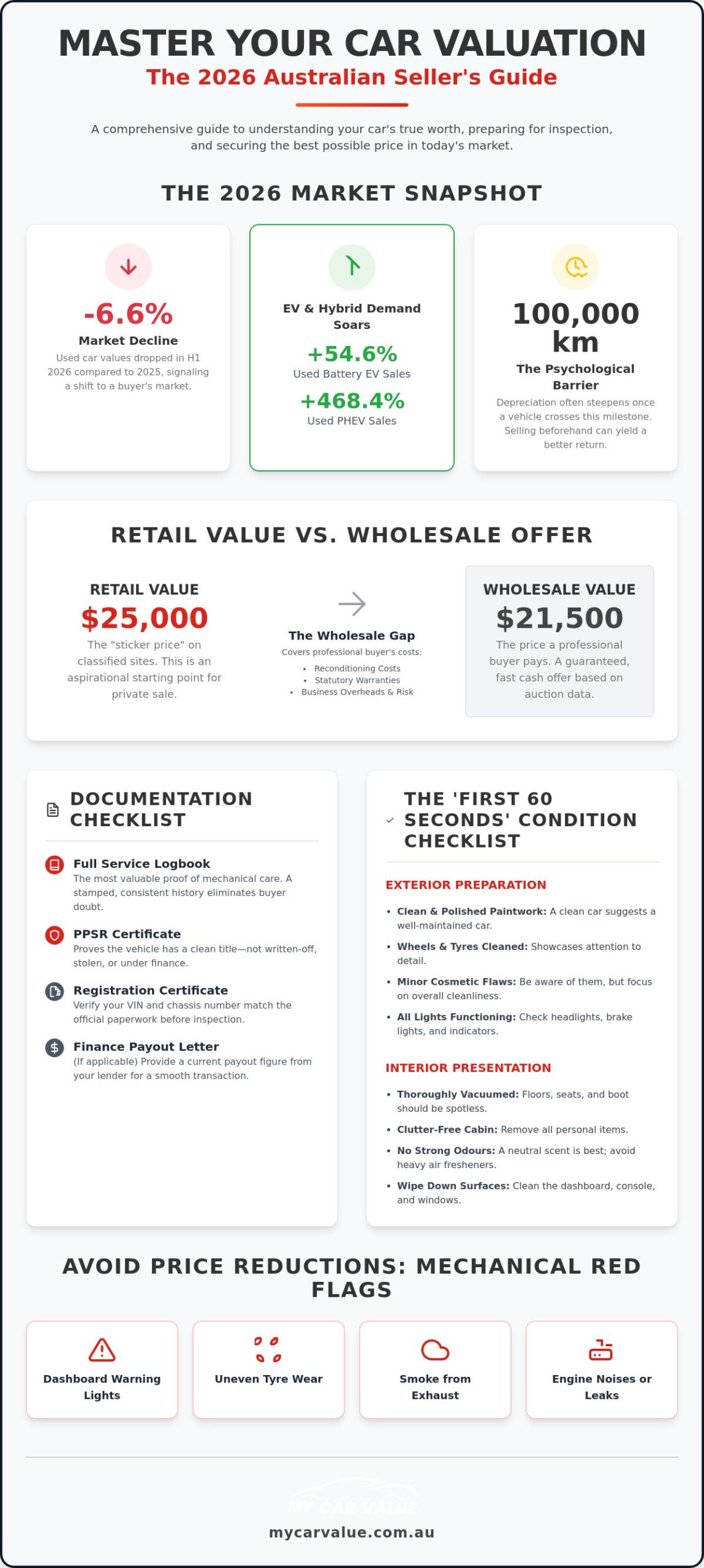
The Australian used car market has shifted significantly from the post-pandemic price surges. In the first half of 2026, the overall market saw a 6.6% decline compared to the same period in 2025. This transition marks a return to a buyer’s market. Increased competition from affordable new Chinese brands like BYD, MG, and GWM is putting downward pressure on used car prices. To accurately value your vehicle today, you must look past outdated 2024 or 2025 benchmarks and focus on current data.
The market value of a motor vehicle is ultimately determined by what a buyer is willing to pay right now, not what you hope to receive. Professional buyers offer more stability than the private market because their offers are based on national auction data rather than local emotion. While private sales might promise a higher figure, they often involve weeks of waiting and failed negotiations. Professional buyers provide a guaranteed exit strategy in a price-sensitive climate.
Mileage remains a critical factor in 2026. The 100,000km mark is still a significant psychological barrier for many Australian buyers. Once a vehicle crosses this threshold, its depreciation curve usually steepens. If your car is approaching this limit, selling it now will likely return a much better result than waiting another six months. Mechanical provenance and documented care are the primary ways to offset this natural depreciation.
The Difference Between Wholesale and Retail Value
Retail value is the “sticker price” you see on classified sites. This figure is often an aspirational starting point that includes a buffer for negotiation. Wholesale or trade-in value is what a professional buyer pays to acquire stock. This “wholesale gap” exists because the professional buyer assumes the risk of the sale, covers the cost of statutory warranties, and invests in mechanical reconditioning. When you value your vehicle, don’t mistake a high-end retail listing for a guaranteed cash offer.
Current 2026 Market Drivers in Australia
Used electric vehicles (EVs) and hybrids are currently bucking the general market decline. Used battery EV sales rose by 54.6% in early 2026, while PHEV sales increased by 468.4%. If you are selling a fuel-efficient model, you are in a strong position. Conversely, large petrol SUVs and utes are more sensitive to fuel price fluctuations. While new car supply has improved, specific high-demand models still face waiting lists. This scarcity continues to support the value of late-model, well-maintained used cars.
The Documentation Checklist: Organising Your Paperwork for a Faster Sale
Professional buyers prioritise transparency over everything else. A clean car might attract interest, but a clean history closes the deal. When you prepare to value your vehicle, start with the glovebox. Organising your documents early prevents delays and stops buyers from chipping away at your price due to missing information. Complete records prove you have maintained the car properly, which reduces the buyer’s risk and increases your leverage.
When you are Organising Your Paperwork, ensure you have the original registration certificate and proof of identity ready. If the car is still under finance, you need a current payout letter from your lender. Professional buyers handle these transactions daily and can often settle the finance directly, but they need the exact figures to proceed. This transparency allows buyers to accurately value your vehicle without factoring in “hidden risk” margins.
The Power of a Full Service History
A stamped logbook is the most valuable document in your car. It is the only objective proof of mechanical care. In the 2026 market, buyers prefer a consistent dealer or reputable specialist service history over a collection of loose receipts in a shoebox. If you have lost your book, contact the service centres where the work was performed. They can often print a summary or restamp a replacement book. This effort pays for itself by preventing “missing history” deductions that can total thousands of dollars.
Title and Financial Transparency
Expect every professional buyer to run a PPSR (Personal Property Securities Register) check. This report confirms the vehicle hasn’t been written off, stolen, or encumbered by an undisclosed loan. You should verify your VIN and chassis number against your registration papers before the inspection to ensure they match perfectly. For a deeper dive into the mechanics of pricing, see our Valuation of Vehicles: The Definitive 2026 Australian Guide.
Don’t overlook the small items that complete the package. Locate your spare key, the owner’s manual, and any radio or navigation codes. A missing modern smart key can cost upwards of $500 to replace; a cost the buyer will certainly deduct from their offer. Finally, check your rego status. A car with six months of registration is far more attractive than one about to expire. Once your documents are in order, you can Value My Car using our streamlined platform to see how your preparation translates into a real-world offer.
The Condition Checklist: Preparing Your Vehicle for Professional Inspection
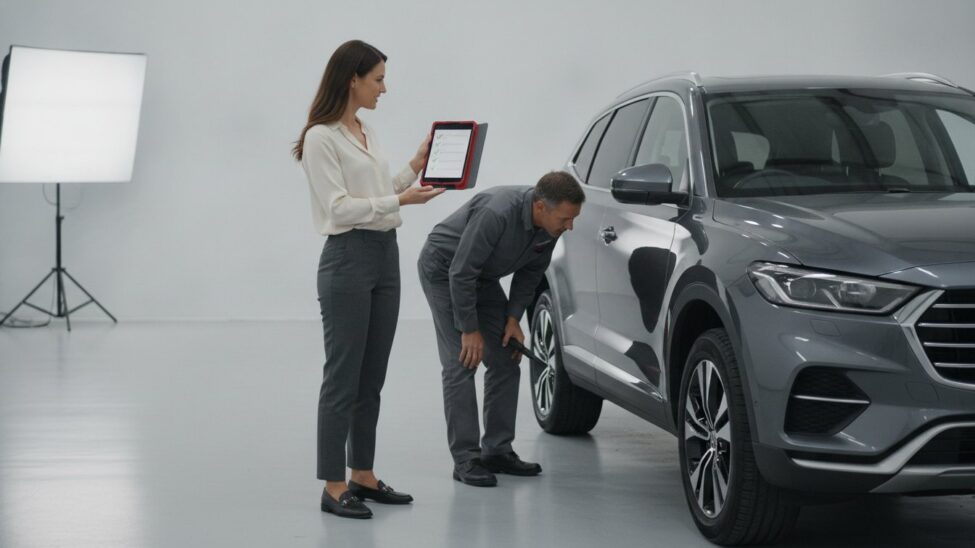
Professional buyers operate on a “First 60 Seconds” rule. Within a minute of walking up to your car, an experienced buyer has already formed an opinion on its worth. They look for signs of neglect that suggest deeper mechanical issues. If the exterior is covered in road grime or the cabin smells of stale cigarette smoke, the buyer assumes you’ve treated the engine with similar disregard. To effectively value your vehicle, you must present it as a turn-key asset that requires zero reconditioning.
Interior hygiene is just as critical as the paintwork. Odours from pets or tobacco are notoriously difficult to remove and can lead to significant price deductions. Don’t simply hang a scented tree from the mirror; this often signals you’re hiding something. Instead, use an odour neutraliser or have the carpets steam cleaned. A spotless interior suggests a careful owner, which builds the trust necessary to secure a premium offer. Buyers also check high-wear areas like the steering wheel, driver’s seat bolsters, and pedal rubbers for signs of excessive use that doesn’t match the odometer reading.
Tyres and brakes are the most common “low-ball” triggers. If your tyres are near the wear indicators or the brake discs have a noticeable lip, a professional buyer will deduct the full retail cost of replacements. You don’t necessarily need to fit brand-new premium tyres, but ensuring the existing ones are scrubbed clean and have legal tread depth prevents an easy negotiation point for the buyer. Check that all tyres match in brand and tread pattern across each axle, as mismatched sets are a red flag for corner-cutting maintenance.
Exterior and Cosmetic Rectification
A professional detail offers a much higher return on investment than a simple home wash. Specialists can remove light “shopping trolley” dints and swirl marks in the clear coat that make a car look tired. One of the most effective tricks is headlight restoration. Cloudy, yellowed plastic lenses instantly age a vehicle. Using a basic restoration kit to bring back the clarity can make a car look years younger and significantly help value your vehicle at the top end of its bracket.
Mechanical Integrity and Safety
Open the bonnet and check for fluid leaks. A layer of dust is fine, but fresh oil or bright green coolant spray suggests an impending repair bill. Ensure the car starts easily from cold without blowing smoke. If you have any dashboard warning lights, have them diagnosed or cleared before the inspection. Professional buyers will always plug in a diagnostic tool; being honest about a minor sensor issue is better than letting them discover it themselves. For more on how maintenance records support these physical checks, see our Car Service History Check: The Australian Guide to Maximising Value (2026). This preparation ensures you meet the official vehicle selling requirements for a transparent and rapid transaction.
Strategic Research: Evaluating Online Estimates vs Real-World Quotes
Online valuation tools are a useful starting point, but they don’t buy cars. To accurately value your vehicle, you need to understand that most digital estimates rely on historical data that can be four to eight weeks behind the live market. While sites like Redbook are industry staples, they often fail to capture sudden shifts in demand or the immediate impact of new model releases from Chinese competitors. Use these tools to establish a price floor, but don’t treat them as a guaranteed payday. Professional buyers look at live auction throughput to determine what a car is worth this afternoon, not what it was worth last month.
Emotional attachment is the most common barrier to a successful sale. You might remember the family road trips and the car’s unwavering reliability, but a professional buyer only sees a depreciating asset. Over-valuing your car because you recently replaced the battery or spent $200 on a professional detail is a mistake. These are basic maintenance requirements, not value-adding upgrades. Real-world quotes are based on cold, hard data: current auction results, local stock levels, and the mechanical integrity discussed in our previous section.
Local supply dynamics also play a massive role in your final figure. If you’re selling a common white SUV in a major metropolitan centre like Sydney or Melbourne, an oversupply of similar models will inevitably drive your price down. Conversely, a unique or high-demand hybrid might fetch a premium in Perth or Adelaide. National averages are helpful for research, but your specific postcode and local competition dictate the actual cash offer.
Decoding Online Valuation Tools
Different websites use different algorithms. One might prioritise retail listing prices, while another focuses on wholesale auction results. This is why you’ll often see a $3,000 gap between two estimates for the same car. The most important metric is the “Adjusted Value.” This calculation takes your specific odometer reading into account. High-kilometre vehicles are penalised heavily in 2026, even if they’ve been maintained perfectly. For a deeper look at these variables, read our How to Estimate Car Worth in Australia: 2026 Market Guide.
Moving from Estimates to Firm Offers
An estimate is a guess; a firm offer is a commitment. To get a binding quote, you must provide high-quality photos that show both the car’s best features and its honest flaws. Close-up shots of tyre tread, the driver’s seat bolsters, and any minor scratches build immediate trust with the buyer. Describe wear and tear accurately from the start. If you hide a dent in a photo, the buyer will simply reduce their offer during the physical inspection. You can start this process using a Vehicle Market Value Calculator: How to Estimate Your Car’s Worth in 2026 to see where your car sits in the current landscape.
Executing the Sale: Connecting with Professional Used Car Buyers
Efficiency is the defining characteristic of a successful sale in the 2026 market. While private listings might promise a slightly higher headline figure, they rarely account for the “time is money” factor. Weeks spent answering messages from “tyre kickers” and waiting for people who never show up quickly erodes any potential profit. When you choose to value your vehicle through a professional buyer network, you’re prioritising a guaranteed outcome over a hopeful listing. This pragmatic approach allows you to move from an initial inquiry to a cleared payment in as little as 24 hours.
Security is another major driver for Australian sellers today. Meeting strangers for test drives carries inherent risks, including insurance complications and potential theft. Professional buyers eliminate these headaches. They provide secure, immediate bank transfers and handle the collection of the vehicle from your home or workplace. This transparency creates an atmosphere of trust that private classifieds simply cannot match. My Car Value acts as the essential facilitator in this process, connecting you with reputable Used Car Buyers who value speed and accuracy as much as you do.
Why Professional Buyers Beat Private Sales
In many Australian states, selling a car privately requires a valid Roadworthy Certificate (RWC) or safety certificate. This often involves costly mechanical repairs just to make the car legal for sale. Many professional buyers will purchase vehicles “as is,” assuming the responsibility for reconditioning and certification themselves. This saves you the upfront cost and the stress of visiting a mechanic. You avoid the risk of a private buyer returning weeks later with a complaint about a minor mechanical fault. Once the deal is done with a professional, the liability ends.
Next Steps for Your Valuation
Once you’ve completed your research and prepared the car, it’s time to finalise the transaction. Perform a final 10-minute check of the cabin to ensure no personal items or charging cables are left behind. Have your VIN and current odometer reading ready for the final quote verification. For a complete look at the broader market, see our Sell My Car: The Ultimate 2026 Guide to Selling Your Vehicle in Australia. This document provides the final layers of strategy needed to value your vehicle with total confidence. By following this methodical checklist, you’ve moved from a position of uncertainty to one of absolute market authority.
The 2026 market rewards sellers who are prepared, honest, and decisive. Use our platform to Value My Car and connect with a buyer who respects your time and the provenance of your vehicle.
Finalise Your 2026 Sales Strategy
The 2026 Australian used car market demands more than just a clean exterior. To successfully value your vehicle, you must bridge the gap between aspirational retail prices and real-world wholesale data. Organising your logbook history and obtaining a clear PPSR report are the most effective ways to protect your price from common buyer deductions. These documents prove your car’s provenance; they transform a standard inspection into a transparent transaction.
Presentation still dictates the opening offer. Addressing minor cosmetic flaws and ensuring mechanical integrity prepares you for a fast, definitive sale. Professional buyers provide the stability and speed required in a modern, price-sensitive market. You don’t have to deal with the stress of private classifieds or the frustration of tyre kickers who never follow through.
It’s time to take the final step with confidence. Our national network of professional used car buyers is ready to provide a transparent, data-driven offer based on current market conditions. Move forward with a partner that respects your time and your vehicle’s true worth.
Frequently Asked Questions
How much does it cost to value your vehicle in Australia?
Getting a digital estimate to value your vehicle is typically free on most Australian platforms. Professional buyers use these tools to provide a baseline before a physical inspection. You should avoid paying for basic valuation data that is readily available online through reputable car buying services.
Will a professional buyer still buy my car if it has a blown engine?
Professional buyers will often purchase vehicles with major mechanical issues, including blown engines. They evaluate the car based on its salvage or parts value rather than its retail potential. This is a much faster solution than trying to find a private buyer for a non-running vehicle, which can take months.
Does having a full service history actually increase my car’s value?
A complete logbook history is the single most important factor in retaining your car’s value. It provides documented proof of maintenance and significantly reduces the risk for the next owner. Vehicles with missing logbooks often face price deductions of several thousand dollars because the mechanical integrity cannot be verified.
Can I value my car if it still has finance owing on it?
You can definitely value your vehicle and sell it even if it is currently under finance. Most professional buyers are equipped to settle the remaining balance with your lender as part of the transaction. You simply need to provide a current payout letter from your financier to ensure the figures are accurate.
How does the colour of my vehicle affect its resale value?
Neutral colours like white, silver, and grey are the safest bets for maintaining high resale value in Australia. These shades appeal to the broadest range of buyers and are easier for dealerships to move. High-visibility or niche colours may attract lower offers due to their limited market appeal and longer listing times.
What is the difference between Redbook value and market value?
Redbook values are historical benchmarks based on past sales data over a specific period. Market value is the live price a buyer is willing to pay right now based on current supply and demand. In the 2026 climate, market value is influenced by immediate factors like fuel prices and the availability of new models.
How often should I update my vehicle’s valuation?
Review your car’s value every three months or before you cross a major 10,000km threshold. Depreciation is not always linear. Sudden shifts in the used car market, such as a surge in used EV demand, can change your car’s worth in a matter of weeks.
Do aftermarket modifications like bull bars or roof racks add value?
Aftermarket modifications rarely provide a dollar-for-dollar return on investment and can sometimes decrease your car’s value. While a bull bar or roof rack is useful for specific users, professional buyers often prefer vehicles in their original factory condition. Some modifications can even limit the number of potential buyers in the secondary market.