

How to Find Out What My Car is Worth in Australia: A Comprehensive Guide
Most car owners leave money on the table simply because they don’t know what their vehicle is actually worth. If you’ve been wondering how to find out what your car is worth in Australia, you’re not alone. It’s one of the most common challenges facing sellers today, and the cost of getting it wrong can be significant.
That uncertainty is completely understandable. The Australian used car market shifts constantly, influenced by factors like fuel prices, seasonal demand, and the popularity of specific makes and models. Without a clear starting point, it’s easy to accept a lowball offer or price yourself out of a quick sale entirely.
This guide cuts through the confusion. You’ll discover the most reliable valuation methods available to Australian sellers, learn which factors genuinely move the needle on your car’s price, and understand how to compare offers with confidence. Whether you’re ready to sell now or just exploring your options, you’ll finish this article with a clear, practical roadmap to understanding your car’s true market value and connecting with the right buyers to make it happen.
Key Takeaways
- Knowing how to find out what your car is worth in Australia starts with understanding the key factors that drive market value – and this guide walks you through every one of them.
- Reliable online valuation tools and the right documents can give you an accurate, data-backed price estimate before you speak to a single buyer.
- Your VIN is more powerful than most sellers realise – discover how this simple identifier can strengthen your valuation and build buyer confidence.
- Connecting with professional used car buyers through a platform like My Car Value removes the guesswork and puts you in a stronger negotiating position.
- Strategic timing and a few targeted preparation steps can meaningfully increase what buyers are willing to pay – learn which moves deliver the biggest return.
Understanding Car Value: What Does It Mean?
Car value isn’t a single fixed number. It’s a dynamic figure shaped by the market, your vehicle’s history, and who’s doing the buying. Before you can figure out how to find out what your car is worth in Australia, you need to understand what “value” actually means in practice – because the number you see on one platform won’t necessarily match what a dealer offers or what a private buyer is willing to pay.
At its core, car value represents what someone is prepared to exchange for your vehicle under specific conditions. Those conditions matter enormously. The same car can carry three different price tags depending on whether you’re trading it in, selling privately, or listing it through a professional buyer network.
Types of Car Values Explained
Understanding the distinctions between value types puts you in a stronger position from the outset:
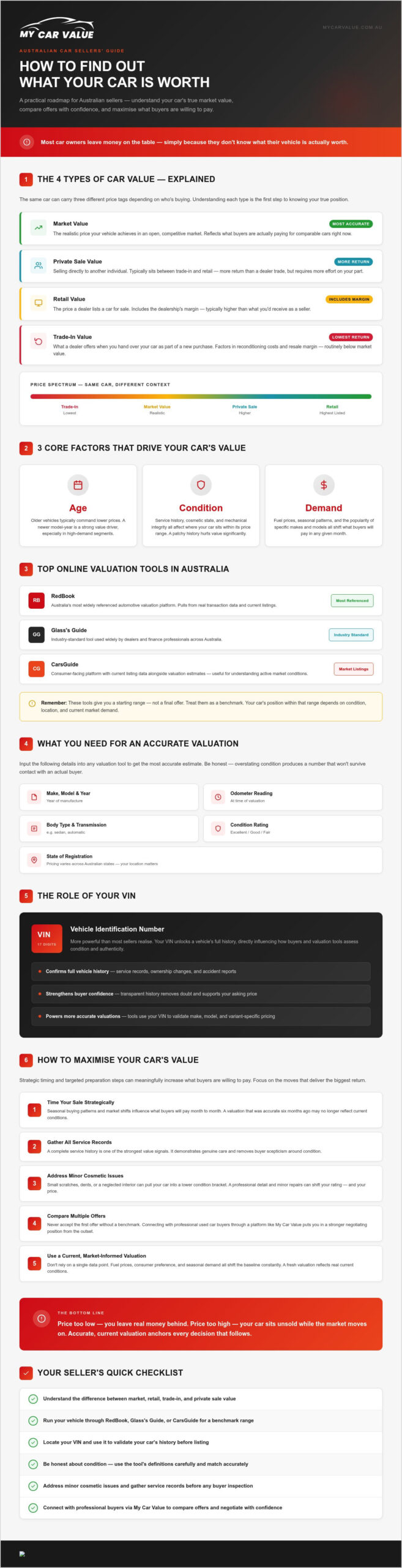
- Market value: The realistic price your vehicle would achieve in an open, competitive market. This is the most accurate reflection of what buyers are actually paying for comparable cars right now.
- Retail value: The price a dealer lists a car for sale. This figure includes the dealership’s margin, so it typically sits higher than what you’d receive as a seller.
- Trade-in value: What a dealer offers when you hand over your car as part of a new purchase. Dealers factor in reconditioning costs and resale margin, so trade-in offers routinely come in below market value.
- Private sale value: What you can realistically achieve selling directly to another individual. This typically sits between trade-in and retail, offering more return than a dealer trade but requiring more effort on your part.
Three core factors drive where your car sits within these ranges: age, condition, and market demand. A well-maintained five-year-old SUV in a high-demand segment will command a premium. A similar vehicle with a patchy service history and cosmetic damage won’t. The Vehicle Identification Number (VIN) plays a quiet but important role here too – it unlocks a vehicle’s full history, which directly influences how buyers and valuation tools assess condition and authenticity.
Why Accurate Valuation Matters
Price your car too low and you leave real money behind. Price it too high and it sits unsold while the market moves on. Neither outcome serves you well.
Accurate valuation anchors every decision that follows: how you negotiate, which buyers you engage, and how quickly you close. Market trends shift the baseline constantly. Fuel price movements, changes in consumer preference, and seasonal buying patterns all influence what buyers will pay in any given month. A valuation that was accurate six months ago may no longer reflect current conditions.
This is precisely why understanding how to find out what my car is worth in Australia requires more than a single data point. It requires a current, market-informed picture – which is exactly what a platform like My Car Value is built to deliver.
How to Get an Accurate Car Valuation in Australia
Getting a reliable valuation doesn’t require a trip to a dealership or hours of research. With the right tools and documents in hand, you can build a clear, data-backed picture of your vehicle’s worth in under 30 minutes. Here’s exactly how to do it.
Using Online Valuation Tools
Several platforms serve the Australian market, with RedBook, Glass’s Guide, and CarsGuide being the most widely referenced. Each pulls from real transaction data and current listings to generate estimated price ranges. The key distinction: these tools give you a starting range, not a final offer. Treat them as a benchmark, not a binding number.
To get the most accurate result from any tool, you’ll need to input:
- Make, model, and year of manufacture
- Odometer reading at the time of valuation
- Body type and transmission (e.g., sedan, automatic)
- Condition rating, typically across categories like excellent, good, or fair
- State of registration, as pricing can vary across Australian states
Be honest about condition. Overstating it produces a number that won’t survive contact with an actual buyer. Understating it leaves money on the table. Use the tool’s condition definitions carefully and match your vehicle to them accurately.
Once you receive your estimate, note the range rather than fixating on the midpoint. The spread between low and high reflects real market variability. Your car’s position within that range depends on the factors covered next.
Documents You Need for Valuation
Paperwork isn’t a formality. It directly shapes the number a buyer or valuation tool assigns to your vehicle.
Gather these before you start:
- Certificate of Registration: Confirms ownership, state, and current registration status. Expired or interstate registration can reduce perceived value.
- Full service history: A complete logbook is one of the most powerful value drivers available. It demonstrates consistent maintenance and removes uncertainty about the vehicle’s mechanical condition.
- VIN (Vehicle Identification Number): Found on your dashboard, door jamb, or registration papers. The VIN unlocks a vehicle’s full build specifications and enables history checks through services like PPSR, confirming whether the car carries any outstanding finance or has been written off.
- Any repair or modification records: Documented repairs add credibility. Undisclosed modifications, particularly non-compliant ones, can reduce value significantly.
A patchy or missing service history is one of the most common reasons sellers receive offers below their expectations. Buyers price in the uncertainty. If you’re asking how to find out what my car is worth in Australia with confidence, having this documentation complete is non-negotiable.
Once your documents are ready and you’ve cross-referenced at least two valuation tools, you’ll have a grounded, defensible price range. Platforms like My Car Value take this a step further, connecting you with professional used car buyers who assess your vehicle against live market data, so the offer you receive reflects what buyers are actually paying right now.
The Role of VIN in Car Valuations
Your Vehicle Identification Number is a 17-character code that functions as your car’s permanent fingerprint. No two vehicles share the same VIN, and that uniqueness carries real weight when you’re trying to figure out how to find out what my car is worth Australia. It’s not just an administrative detail. It’s a direct line into your vehicle’s full history, specifications, and legal status – all of which influence what buyers are willing to pay.
Finding Your VIN
Locating your VIN takes less than a minute. Check these spots first:
- Dashboard (driver’s side): Visible through the windscreen at the base of the windshield
- Driver’s door jamb: Stamped on a plate or sticker inside the door frame
- Registration certificate: Listed alongside your vehicle details
- Engine bay: Stamped directly on the engine block or firewall
If your VIN plate is damaged, missing, or illegible, contact your state’s road authority before proceeding. A missing or tampered VIN raises immediate red flags for buyers and can stall a sale entirely. Have it verified and documented before you approach any buyer or valuation platform.
Have your VIN ready before you start any valuation. It removes ambiguity about your vehicle’s exact build specifications and prevents mismatches that can skew your estimated price range.
How VIN Impacts Your Car’s Value
Buyers don’t just take your word for a vehicle’s condition. They verify it. A VIN enables a PPSR check through the Australian Government’s Personal Property Securities Register, which confirms whether your car carries outstanding finance, has been written off, or is listed as stolen. A clean PPSR result strengthens buyer confidence immediately. An unresolved flag does the opposite, often causing buyers to walk away or reduce their offer significantly.
Beyond finance checks, VIN data connects directly to your vehicle’s factory specifications. It confirms the original engine, transmission, trim level, and compliance plate details. This matters because it allows valuation tools and professional buyers to match your car precisely against comparable sales data. A generic search by make and model alone can return a wide, imprecise range. A VIN-specific search narrows that range to vehicles that genuinely reflect yours.
Professional used car buyers within a network like My Car Value use VIN data as a core part of their assessment process. It’s how they verify what you’re selling matches what you’re claiming, and it’s how you, as a seller, can back your asking price with something concrete. Accurate buyer matching starts with accurate vehicle identification, and the VIN makes both possible.
Treat your VIN as a selling tool, not just a registration formality. It’s one of the simplest ways to build credibility and support a stronger valuation from the outset.
Connecting with Professional Buyers
Once you know how to find out what my car is worth Australia, the next challenge is finding buyers who will actually pay that price. Private sales take time, attract tyre-kickers, and require you to handle every step yourself. Professional used car buyers change that equation entirely. They assess your vehicle against live market data, move quickly, and remove the friction that makes private selling so exhausting.
Platforms like My Car Value connect sellers directly with a network of professional buyers who operate in the Australian market. Rather than fielding enquiries from strangers or waiting weeks for a private sale to close, you receive offers from buyers who are ready to transact. The process is structured, transparent, and designed to get you to a fair outcome without the usual back-and-forth.
Preparing Your Car for Sale
Presentation matters. Before engaging any buyer, take these steps:
- Clean the vehicle thoroughly: A full interior and exterior clean signals care and maintenance. Buyers notice the difference immediately, and it directly influences their offer.
- Compile your documentation: Service logbooks, registration certificate, VIN details, and any repair records should be organised and ready to present. Gaps in paperwork create doubt and reduce offers.
- Set a price grounded in your valuations: Use the range you’ve established through RedBook, Glass’s Guide, or CarsGuide as your anchor. Know your minimum acceptable figure before any conversation begins.
Don’t underestimate the impact of minor cosmetic fixes either. Replacing a cracked wiper blade or touching up a scuff costs very little but removes easy objections from a buyer’s checklist.
The Selling Process with Professional Buyers
Working with professional buyers through My Car Value follows a clear sequence. You submit your vehicle details, receive an offer based on current market data, and then decide whether to proceed. There’s no obligation to accept.
When negotiating, lead with your documentation. A complete service history and clean PPSR result are concrete evidence that supports your asking price. Don’t open by discounting; let the buyer make the first move and respond from a position of informed confidence.
Once you agree on a price, confirm the payment method and transfer timeline in writing before handing over keys or paperwork. Verify that the registration transfer process aligns with your state’s requirements, as procedures differ across Australian jurisdictions. Professional buyers typically handle much of this administrative process, but knowing what to expect keeps you in control.
Sellers in Sydney, Melbourne, Brisbane, Perth, and Adelaide can connect with professional buyers through My Car Value’s local networks, matching you with buyers active in your specific market.
Connect with professional used car buyers in your area and get a market-based offer today.
Maximising Your Car’s Value in Australia
Knowing how to find out what my car is worth Australia is only half the equation. The other half is acting on that knowledge strategically. Valuation gives you a number. Timing, preparation, and market awareness determine whether you actually achieve it.
Timing Your Sale
The Australian used car market isn’t static. Demand shifts across the calendar year, and selling at the right moment can meaningfully lift your final price.
Tax time, particularly the period leading up to 30 June, sees a consistent uptick in buyer activity as businesses and individuals look to make vehicle purchases before the financial year closes. The lead-up to summer also drives demand for utes, 4WDs, and SUVs as buyers prepare for holiday travel. Convertibles and sports cars tend to attract more interest in spring, when warmer weather brings discretionary buyers back into the market.
Conversely, listing in the middle of winter or immediately after a public holiday typically means fewer active buyers and more negotiating pressure on price. If your timeline allows flexibility, align your listing with a demand peak rather than selling into a quiet period.
Fuel price movements matter too. When petrol prices climb sharply, demand for smaller, fuel-efficient vehicles rises while large-engine models soften. Track these shifts and position your vehicle accordingly in your listing copy.
Using Market Data for Better Offers
A valuation figure without context is just a number. What gives it power is comparison. Before accepting any offer, cross-reference it against current listings for comparable vehicles on major Australian platforms. Look at cars with similar kilometres, condition, and specification in your state. If your offer sits below the lower end of that range without clear justification, push back with evidence.
This is where accurate, up-to-date valuations become a genuine negotiating asset. Buyers expect sellers to be uninformed. When you arrive at a conversation with documented market data, a clean service history, and a verified PPSR result, you shift the dynamic entirely.
Platforms like My Car Value support this process directly. By connecting you with professional used car buyers who assess vehicles against live market data, they remove the guesswork and give you offers grounded in what buyers are actually paying right now, not what a static guide suggested six months ago.
Before you list or engage any buyer, run through this final checklist:
- Valuation confirmed: Cross-referenced across at least two tools
- Documentation complete: Service logbook, registration certificate, VIN details, and repair records ready
- PPSR check done: Clean result in hand to share with buyers
- Vehicle presented: Thoroughly cleaned inside and out
- Minimum price set: Know your floor before any negotiation begins
- Timing considered: Listed during a demand peak where possible
Selling your car for the best price isn’t about luck. It’s about preparation, timing, and knowing how to find out what my car is worth Australia before a single buyer makes contact. Do that groundwork, and you negotiate from strength rather than uncertainty.
Get a market-based valuation and connect with professional buyers through My Car Value today.
Your Next Step Starts Here
Figuring out how to find out what my car is worth Australia doesn’t have to be complicated. Get your documents together, run your VIN, cross-reference at least two valuation tools, and approach buyers with a number you can defend. Those steps alone put you ahead of most sellers.
Timing matters. Preparation matters. And connecting with professional buyers who use live market data matters more than most sellers realise. When all three come together, you’re not guessing at your car’s value. You’re negotiating from a position of genuine confidence.
My Car Value gives you access to accurate market valuations, a network of professional used car buyers, and expertise built specifically for the Australian market. The process is straightforward, transparent, and designed to get you a fair result without the usual hassle.
Don’t settle for less than your car is worth.
Frequently Asked Questions
What factors affect my car’s valuation in Australia?
Several variables directly influence what buyers will pay for your vehicle. Odometer reading, age, condition, service history, and the popularity of your make and model in the current market all carry weight. Location matters too, as demand for certain vehicle types varies across Australian states. A well-maintained ute in regional Queensland, for example, will attract different interest than the same vehicle listed in inner-city Melbourne.
External factors like fuel prices and broader economic conditions also shift valuations. When petrol prices rise sharply, fuel-efficient vehicles attract stronger demand while large-engine models soften. Staying across these market movements helps you position your vehicle at the right moment.
How can I ensure I get a fair price for my car?
Understanding how to find out what my car is worth Australia is the foundation of any fair outcome. Cross-reference at least two valuation tools, compile your documentation, and run a PPSR check before engaging any buyer. Knowing your vehicle’s market position means you can identify a low offer immediately rather than accepting it out of uncertainty.
Connecting with professional used car buyers through a platform like My Car Value adds another layer of confidence. Offers from professional buyers are grounded in live market data, which removes the guesswork that private negotiations often involve.
What documents do I need to sell my car?
At minimum, you’ll need your certificate of registration, a valid form of identification, and your vehicle’s service logbook. A PPSR certificate confirming no outstanding finance is increasingly expected by serious buyers and speeds up the transaction considerably. If your car has had any repairs or modifications, keep those records accessible too.
Requirements vary slightly across Australian states, so confirm the specific transfer process with your local road authority before finalising any sale. In most jurisdictions, the seller is responsible for providing a roadworthy or safety certificate, depending on the state.
Is it worth getting a professional valuation for my car?
Yes, particularly if your vehicle is high-value, has an unusual specification, or has had accident repairs. Online tools provide a useful benchmark range, but a professional assessment accounts for nuances that automated tools miss, such as rare factory options, condition anomalies, or recent market shifts in your specific segment.
For most everyday vehicles, a combination of reputable online tools and an offer from a professional buyer network gives you sufficient market intelligence to negotiate confidently. The key is using multiple data points rather than relying on a single estimate.
Can I sell my car without a VIN?
Selling without a verifiable VIN is legally problematic and practically very difficult. In Australia, a missing or tampered VIN raises immediate concerns about a vehicle’s legitimacy, and most professional buyers won’t proceed without it. If your VIN plate is damaged or illegible, contact your state’s road authority to have it verified and documented before approaching any buyer.
A clear, traceable VIN isn’t just a legal requirement; it’s a selling asset. It allows buyers to run history checks, confirm factory specifications, and transact with confidence. Don’t attempt to sell without it in place.
How do I find out if my car has any outstanding finance?
Run a search through the Australian Government’s Personal Property Securities Register (PPSR) at ppsr.gov.au. A search costs a small fee and returns a report confirming whether your vehicle has any registered financial interests, has been written off, or is listed as stolen. The result is immediate and the report is accepted by buyers as credible evidence of a clean title.
If the search returns an outstanding finance encumbrance, contact the financier directly to arrange a payout before proceeding with any sale. Selling a vehicle with undisclosed finance is illegal and can expose you to serious liability.
What should I do if my car has been in an accident?
Disclose the accident history upfront and provide documentation of all repairs carried out. Attempting to conceal prior damage is both unethical and legally risky in Australia. Buyers who discover undisclosed damage after purchase can pursue remedies under Australian Consumer Law.
Repaired accident damage doesn’t automatically disqualify a vehicle from achieving a fair price, particularly if the repairs were carried out by a licensed repairer and documented properly. Transparency paired with solid paperwork will always produce a better outcome than concealment. Adjust your price expectations to reflect the vehicle’s history honestly.
How can I improve my car’s value before selling?
Focus on presentation and documentation first, as these deliver the most return for the least cost. A thorough interior and exterior clean, addressing minor cosmetic issues like scuffs or cracked trim, and organising a complete service logbook all remove easy objections from a buyer’s checklist. If your car is due for a service, completing it before listing demonstrates ongoing care.
Avoid over-investing in mechanical repairs that won’t recover their cost in the sale price. Instead, get a pre-sale inspection so you know exactly what a buyer’s mechanic will find, and price accordingly. Informed sellers who present their vehicle honestly and completely consistently achieve stronger offers than those who don’t.