
Best Way to Sell a Car in Australia: The 2026 Ultimate Guide
Did you know that 51.1% of used vehicles sold in mid-2026 had their prices slashed before a buyer signed the paperwork? In a market currently favouring buyers, finding the best way to sell a car in Australia requires more than just a “for sale” sign in the window. You’re likely tired of unreliable private buyers, confusing PPSR requirements, and the frustration of seeing your car’s value drop while it sits on the driveway.
We understand that you want a fast sale without sacrificing your return. This guide provides the exact roadmap to navigate the 2026 landscape with confidence, ensuring you secure a price that reflects true market value with minimal stress. We’ll examine the shifting demand for EVs, the impact of new Chinese brands, and how to use a professional “Value My Car” tool to get an accurate figure before you list. It’s time to stop guessing and start selling with professional precision. By following these steps, you can bypass the low-ball offers and move your vehicle quickly in a competitive market.
Key Takeaways
- Learn how to navigate the 2026 buyer’s market and adjust your strategy based on current supply chain shifts and the rise of new vehicle brands.
- Discover why using a professional car price estimator is the best way to sell a car in Australia to ensure your asking price matches real-time market data.
- Compare the true net return of private listings against professional used car buyers by accounting for the value of your time and compliance costs.
- Master the essential preparation steps, including PPSR checks and service history documentation, to eliminate buyer friction and secure a premium price.
- Access a streamlined path to a secure sale by connecting with a national network of vetted buyers who value transparency and speed.
Evaluating the Australian Car Market: Which Selling Method Suits You?
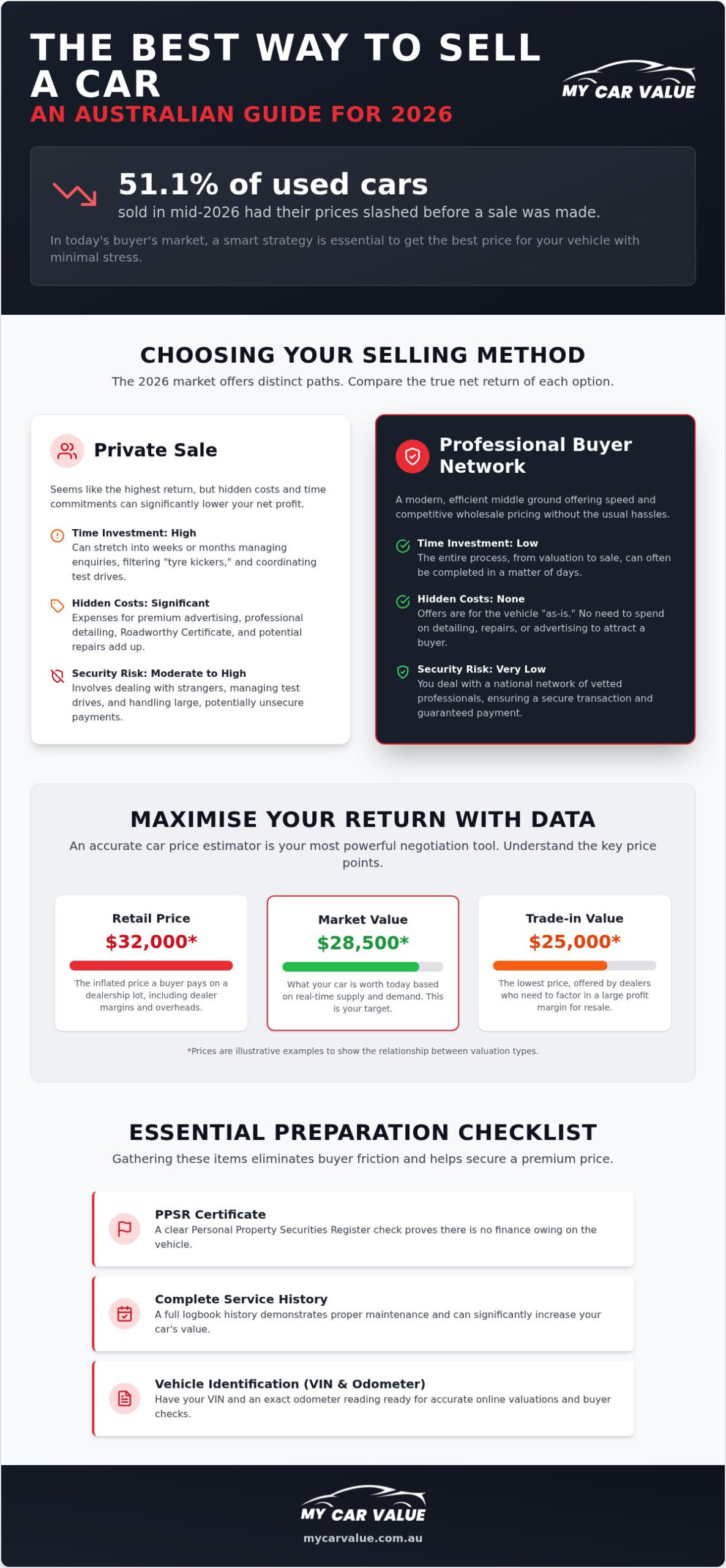
The 2026 Australian automotive landscape has undergone a significant transformation. Supply chain stabilisations have finally caught up with demand, leading to a market that now firmly favours the buyer. For many owners, finding the best way to sell a car in Australia has become a priority as inventory levels rise and selling times lengthen. You are no longer just competing with a few local listings; you’re facing a flooded market where price sensitivity is at an all-time high and buyers have the power to negotiate deeper discounts.
The Private Sale Reality Check
Choosing a private sale often feels like the default option for those seeking the highest possible price. However, this path requires a substantial investment of both time and capital. You’ll need to factor in the costs of premium advertising, professional detailing, and obtaining a mandatory Roadworthy Certificate. Depending on your jurisdiction, these inspections vary in price, and that’s before any necessary repairs are identified to make the vehicle compliant for sale. Beyond the financial outlay, the emotional tax is high. You must manage a constant stream of enquiries, filter out “tyre kickers,” and coordinate test drives with strangers. In a market where buyers have more options than ever, a private sale can easily stretch into a multi-month project that yields a lower net return than originally expected.
The Rise of the Professional Buyer Network
Dealership trade-ins offer ultimate convenience, but they have historically provided the lowest financial return. This has led to the rise of professional used car buyers as a modern middle ground. This method prioritises speed and competitive wholesale pricing without the administrative burden of a private listing. These buyers operate on high-volume models and data-driven valuations, allowing them to offer immediate settlement for vehicles in “as-is” condition. It removes the need for you to spend money on repairs or detailing just to attract a single enquiry.
Some sellers opt for Car brokers in Australia to navigate these waters, but direct professional buyer networks have simplified the process even further. This approach is ideal for time-poor Australians who want to move an asset quickly and securely. By bypassing the traditional dealership lot and the uncertainty of the private market, you can secure a fair price that reflects real-time 2026 market conditions. Ultimately, the best way to sell a car in Australia is to choose the method that aligns with your specific needs for speed, safety, and total net return.
Using a Car Price Estimator to Maximise Your Return
Data wins arguments. An accurate car price estimator is your most powerful negotiation tool because it moves the conversation from opinion to evidence. To find the best way to sell a car in Australia, you must understand three distinct price points. Market Value represents what the car is worth today based on current demand. Trade-in Value is what a dealer pays to ensure they can turn a profit. Retail Price is the inflated figure a buyer pays on a dealership lot. Knowing these figures allows you to set a firm “bottom line” before you speak to any potential buyer.
Inputting specific data into a professional tool bypasses the guesswork that often leads to underselling. Condition and service history are deal-breakers in the 2026 market. A car with a full logbook history and no cosmetic damage always commands a premium. Use your valuation data to identify low-ball offers instantly. If an offer sits significantly below your estimated market value, you have the confidence to walk away and wait for a fair deal.
Step-by-Step: Getting an Accurate Valuation
Gathering your essentials is the first step toward a successful sale. You need your VIN, an exact odometer reading, and a comprehensive list of factory options like sunroofs or upgraded tech packs. Once you have these, input the details into a reputable vehicle market value calculator. Adjust your expectations based on current trends; for instance, SUVs and 4x4s often see higher demand than small sedans. Market value is the intersection of historical data and real-time demand. This figure provides the clarity you need to price your vehicle competitively without leaving money on the table.
Interpreting the Results: Wholesale vs. Private
Understanding the “dealer margin” prevents disappointment during the sale process. Dealers must cover overheads, detailing, and warranty risks, so you won’t receive the full retail price from a professional buyer. However, this method offers speed and security that private listings lack. Use your estimate to spot unrealistic offers from buyers who haven’t done their research. Look at recent comparable sales in your specific category to see how quickly similar models are moving. Once you agree on a fair price and finalise the deal, you must lodge a notice of disposal to complete your legal obligations. Before you enter any negotiation, use a professional service to Value My Car for an impartial baseline.
Private Sales vs. Professional Buyers: A Transparent Comparison
The highest offer isn’t always the best deal. When you calculate the net return, you must subtract advertising costs, repair bills, and the value of your time. For many, the best way to sell a car in Australia is the method that puts cash in the bank with the least amount of friction. Private sales often turn into a “waiting game” that stretches across multiple weekends. Every viewing that doesn’t result in a sale is a lost opportunity. You trade the potential for a slightly higher sticker price for the certainty of a professional transaction.
The Hidden Costs of Selling Privately
Listing your vehicle on major classified sites isn’t free. To actually get eyes on your ad, you often need to pay for “boosted” or “premium” listings. Then there is the Roadworthy Certificate. If your car needs even minor mechanical work to pass, those repairs eat directly into your profit. Beyond the money, there is an emotional tax. Dealing with “low-ballers” who offer half your asking price or “no-shows” who waste your Saturday is a common frustration. You also carry the risk of payment fraud or scams during the handover process.
Why Professional Buyers are Winning in 2026
Efficiency is the primary driver for sellers in 2026. Professional used car buyers have removed the traditional barriers to a quick sale. They use streamlined digital inspections and offer instant digital currency transfers. In many commercial transactions, you don’t even need to provide a Roadworthy Certificate, as the buyer handles the reconditioning process. This allows for same-day settlement, providing immediate liquidity when you need it most.
Security is another major factor. Selling to a vetted professional eliminates the danger of strangers visiting your home for test drives. It also simplifies the paperwork. A professional buyer will typically perform their own Personal Property Securities Register (PPSR) check to verify the car’s history. This transparency protects both parties and ensures the title transfer is handled correctly. If you value your weekends and want a guaranteed payment, bypassing the private market is often the best way to sell a car in Australia. You trade a small percentage of the retail price for total peace of mind and speed.
Essential Preparation: From PPSR Checks to Service History
Transparency is your strongest asset when negotiating a final sale price. Providing a clear, documented history is the best way to sell a car in Australia for its maximum potential value. Buyers in 2026 are risk-averse. They want proof that a vehicle hasn’t been neglected or involved in major accidents. By preparing your documentation before the first inspection, you remove the “fear factor” that often leads to aggressive price haggling.
The Power of the PPSR Report
A Personal Property Securities Register (PPSR) check is a non-negotiable step for any serious seller. For an official government fee of only $2.00, this report proves to a buyer that your vehicle is debt-free. It reveals if there is any financial encumbrance, theft history, or previous write-off status recorded against the VIN. Having this report ready builds immediate trust with professional buyers and private parties alike. If you find a “stale” security interest; a debt you’ve paid off that still appears on the title; contact your financier immediately to have it removed before listing the car.
Mechanical and Aesthetic Readiness
Small issues can lead to large deductions in a buyer’s mind. Address minor “niggles” like blown fuses, worn wiper blades, or chipped paint before showing the car. While a full professional detail isn’t always necessary, cleanliness is vital. A clean engine bay and a vacuumed interior suggest the vehicle has been well-maintained. A complete logbook is equally important. You can learn more about how a car service history check can boost your return and provide the evidence buyers need to pay a premium.
First impressions dictate the flow of the negotiation. If a car looks neglected, a buyer will assume the mechanical components are also failing. Focus on the high-contact areas like the steering wheel, gear shifter, and door handles. When you present a car that is both legally clear and physically clean, you position yourself as a savvy seller. This preparation is the best way to sell a car in Australia while maintaining control over the final price. It turns a potentially stressful inspection into a straightforward confirmation of value.
How My Car Value Simplifies the Australian Selling Process
A valuation is only useful if it leads to a concrete result. Many sellers find a price online but struggle to convert that data into a bank deposit. My Car Value bridges this gap by acting as a savvy intermediary. We provide the tools to understand your vehicle’s worth and then connect you with a national network of professional used car buyers. This direct link removes the layers of complexity found in traditional private classifieds. It’s a modern, data-driven approach that ensures you aren’t just guessing at a fair market price.
The My Car Value Advantage
Our platform offers fast, accurate digital valuations tailored specifically to the Australian market. We don’t just look at broad national averages. We consider the specific demand for your make and model in the current climate. This creates a no-pressure environment where you can explore your car’s worth without committing to a sale immediately. By treating your vehicle as a managed asset rather than just a used car, you maintain control over the transaction. This transparency is the best way to sell a car in Australia while avoiding the stress of low-ball trade-in offers.
Getting Started with Your Sale
The process begins with a simple entry of your vehicle details. Use the Value My Car tool today to receive an impartial estimate based on real-time sales data. Once you have your figure, you can choose to connect with our vetted network of buyers. When these professionals contact you, expect a direct and transparent conversation. They are looking for quality stock and value the same efficiency you do. They handle the heavy lifting, allowing you to focus on the final handover.
For a seamless transition, ensure you have all your keys, service logs, and registration papers ready. Verify that the payment has been cleared in your account before releasing the vehicle. Most professional buyers use instant digital transfers, which provides immediate security. By following this structured path, you bypass the typical hurdles of the used car market. You move from an initial enquiry to a completed sale with minimal effort and maximum return. Selling your car in 2026 doesn’t have to be a second job. Use the right tools to simplify the process and get back to what matters.
Secure Your Best Return in the 2026 Market
Navigating the current automotive landscape doesn’t have to be a burden. You’ve learned that the best way to sell a car in Australia involves leveraging real-time market data and maintaining total transparency with your documentation. By prioritising a professional valuation and preparing your vehicle’s history, you eliminate the uncertainty that leads to low-ball offers. This data-driven approach ensures you enter negotiations from a position of strength rather than guesswork.
Our platform provides the essential tools you need to manage your vehicle as a valuable asset. You can access accurate, real-time Australian market data and connect with a national network of professional buyers who value your time. This streamlined, stress-free selling process is designed to strip away the complexity of traditional methods. It ensures you get a fair price without the friction or security risks associated with private listings. You now have a clear roadmap to a successful and secure transaction.
Take control of your sale and move forward with confidence. You are now equipped to secure a result that reflects your car’s true market value with minimal effort.
Frequently Asked Questions
What is the best way to sell a car in Australia for a fast sale?
Selling to a professional used car buyer is the fastest method because it bypasses the public listing phase entirely. You receive an immediate offer and can often settle the payment within 24 hours. Unlike private listings that may linger for weeks, this approach provides a guaranteed exit strategy. It’s the best way to sell a car in Australia if you need immediate liquidity or want to avoid the administrative burden of managing multiple viewings.
Is a car price estimator accurate for older vehicles?
A professional estimator remains accurate for older vehicles as long as it draws from a deep pool of historical and real-time sales data. For cars over ten years old, the physical condition and odometer reading become the primary value drivers. While high-volume models have more predictable pricing, unique or well-maintained older cars can still be appraised with precision. Providing exact details about your service history ensures the tool generates a figure reflecting current demand.
Do I need a Roadworthy Certificate to sell to a professional buyer?
You generally don’t need to provide a Roadworthy Certificate (RWC) when selling to a licensed professional buyer. These buyers typically purchase vehicles in “as-is” condition and manage any necessary reconditioning or compliance checks internally. This saves you the upfront cost and time required to visit a mechanic for an inspection. Always confirm this with the buyer beforehand, as requirements can vary slightly depending on the specific commercial arrangement and the vehicle’s age.
How do I avoid scams when selling my car privately?
Avoid scams by insisting on secure, verifiable payment methods and meeting potential buyers in person. Never release the vehicle or the signed transfer papers until you’ve confirmed the funds are cleared in your bank account. Be wary of buyers who offer to pay more than the asking price or those who cannot view the car themselves. Professional buyers eliminate this risk entirely by providing a secure, transparent transaction process with immediate digital confirmation of payment.
What documents do I need to sell my car in Australia?
You must have your current registration papers, a valid proof of identity, and a completed transfer of registration form. Providing a full service history and a recent PPSR report is also recommended to prove the vehicle’s status to the buyer. While a Roadworthy Certificate is mandatory for most private sales, it’s often optional when dealing with professional networks. Keep a copy of the signed disposal notice to ensure you’re no longer liable for the vehicle.
Can I sell a car that still has finance on it?
Yes, you can sell a car with outstanding finance by obtaining a formal payout letter from your lender. This document states exactly how much is owed to clear the debt. When you sell to a professional buyer, they can often pay the financier directly and give you the remaining balance. This is the best way to sell a car in Australia when under finance because it ensures the security interest is removed correctly from the official register.
How much does it cost to get a professional car valuation?
Many modern platforms offer professional car valuations for free to help you understand your market position. These digital tools use complex algorithms to analyse thousands of recent transactions across the country. While some specialist independent appraisers may charge a fee for a physical inspection, a data-driven digital valuation provides sufficient accuracy for most sellers. It allows you to establish a firm bottom line for negotiations without any upfront financial commitment or out-of-pocket expenses.
Is trading-in at a dealer always the worst financial option?
Trading-in at a dealership is convenient but typically results in a lower financial return than other methods. Dealers must factor in their own profit margins, GST, and reconditioning costs when making an offer. While it simplifies the process of buying your next car, you’re essentially paying for that convenience with a reduced sale price. Professional used car buyers often provide a more competitive middle ground, offering better wholesale prices while maintaining the same level of speed.