
What Decreases Car Value? 2026 Australian Guide to Avoiding Value Killers
Did you know that by June 2026, over 51% of used cars aged one to five years had their prices slashed before a sale was finalised? It’s a sobering reality for many Aussie sellers who expect a quick result but find themselves facing steep discounts. You’ve likely felt the frustration of seeing online valuation tools give you one figure, only to have a professional buyer point out flaws you didn’t even know mattered. Understanding exactly what decreases car value is the only way to protect your hip pocket when it’s time to move on.
We agree that the selling process should be transparent and free from nasty surprises like hidden PPSR issues or the massive price hit from a missing service history. This guide promises to arm you with the facts you need to maintain your vehicle’s worth and negotiate with total confidence. We will examine the specific value killers in today’s market, from mechanical neglect to the rising influence of new fuel-efficient brands. You’ll get a clear, actionable roadmap to stop the bleed and ensure you walk away with the best possible price for your car.
Key Takeaways
- Distinguish between standard market depreciation and preventable value loss to set a realistic price for your vehicle.
- Identify exactly what decreases car value for professional buyers, focusing on the heavy penalties for missing logbooks and PPSR issues.
- Evaluate how minor exterior scars and interior odours can trigger significant price reductions that outweigh the cost of a professional detail.
- Monitor external market shifts, including fuel price volatility and new model releases, to time your sale for maximum return.
- Conduct a pre-sale audit to address high-ROI repairs and organise your paperwork for a smoother, more confident negotiation.
The Difference Between Natural Depreciation and Value Loss
Selling your car for a fair price requires a clear understanding of market forces. Every vehicle loses worth over time, but there is a distinct line between expected wear and preventable damage. In the 2026 Australian market, depreciation is the predictable reduction in a vehicle’s worth due to age and wear. Value loss refers to the accelerated drop caused by specific, often avoidable, factors. Distinguishing between the two is essential for understanding depreciation as a standard cost of ownership versus identifying what decreases car value through neglect or poor timing.
The “drive-away” effect remains a major factor for new car buyers. Most vehicles lose a significant percentage of their retail price the moment they leave the showroom. This is a long-term market trend that no seller can truly escape. However, understanding this distinction helps you set a realistic asking price. It allows you to separate the money you’ve lost to time from the money you can still save by maintaining the vehicle’s condition.
The “Prime Cost” vs “Diminishing Value” Reality
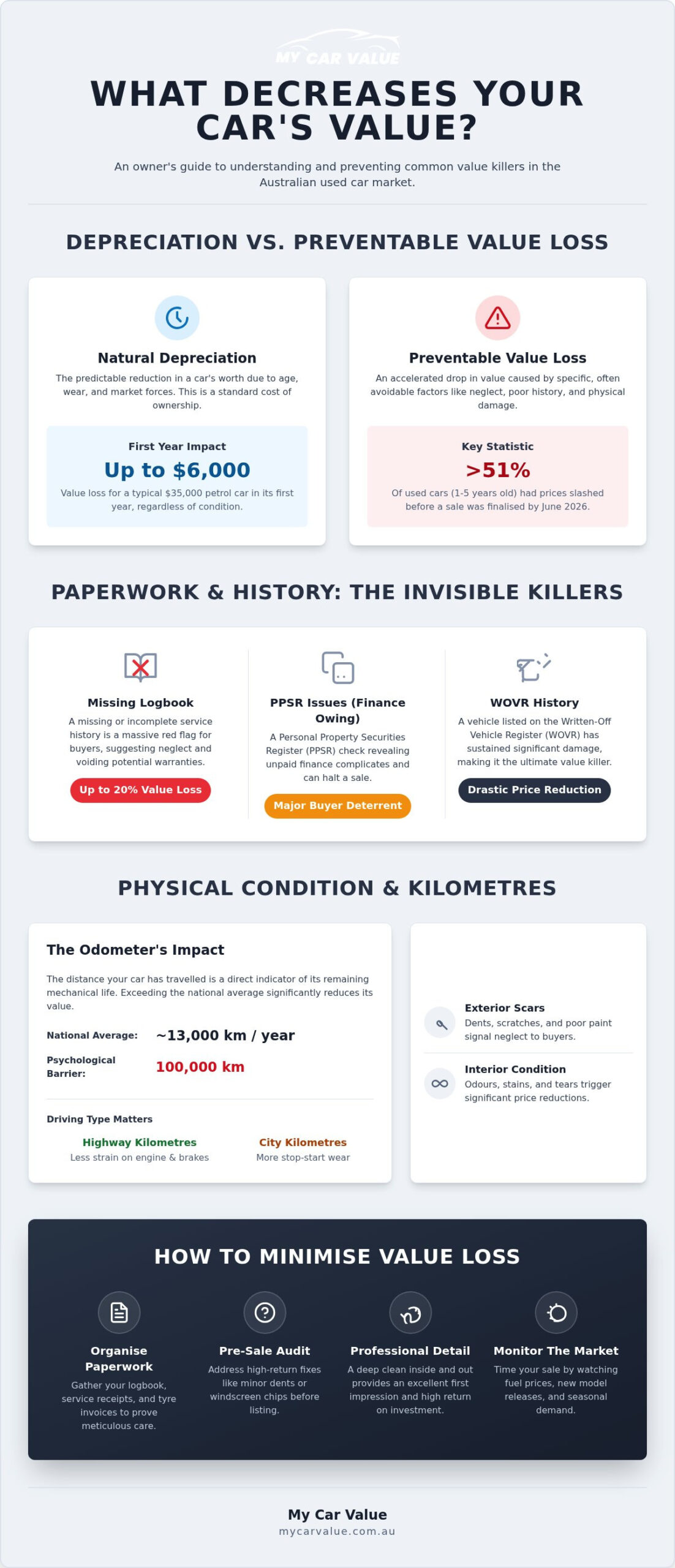
Australian buyers generally prioritise a vehicle’s age when browsing the used market. The first three years typically see the steepest decline in value. During this period, the car transitions from “new” to “used,” losing its initial premium status. Depreciation in 2026 is a steady market-driven decline, where a typical $35,000 petrol car loses up to $6,000 in its first year regardless of condition. Professional buyers use these industry-standard curves to set their baseline offers. If your car is older than five years, the rate of decline usually slows, making the physical condition and history more influential than the manufacture date.
Kilometres: The Odometer’s Impact on Your Wallet
The numbers on your dashboard are a direct indicator of mechanical life remaining. In Australia, the national average is approximately 13,000km per year. If your odometer exceeds this rate, it significantly slashes the resale price. There are also major psychological barriers for local buyers. Crossing the 100,000km mark is a primary example of what decreases car value instantly, as many buyers associate this milestone with the need for expensive major services or timing belt replacements.
Professional valuations also consider the type of driving you do. Highway kilometres are often viewed more favourably than city driving. Constant stop-start traffic in urban centres puts more strain on the brakes, gearbox, and engine. A car with 80,000km of country highway driving may actually be in better mechanical health than a city car with 50,000km. Be prepared to highlight your driving habits if they work in your favour.
Paperwork and History: The Invisible Value Killers
Physical damage is easy to spot, but the most significant price drops often happen on paper. Professional buyers prioritise transparency and risk management. If your documentation is incomplete or your vehicle’s history is clouded, you’re giving a buyer every reason to lower their offer. Understanding what decreases car value behind the scenes is vital for a successful sale in the current Australian market.
A vehicle’s history isn’t just a record of the past. It’s a predictor of future reliability. Buyers use these records to justify their risk. Any gap in the story represents a potential mechanical or legal headache, which translates directly into a lower valuation.
The Logbook: Your Car’s Resume
A missing logbook is a massive red flag that can’t be ignored. In the local market, a vehicle without a complete service history can lose up to 20% of its potential resale price instantly. It’s not just about proving you changed the oil. It’s about warranty protection. By 2026, most manufacturer warranties require strict adherence to service schedules. If you’ve missed a single major service, that warranty might be void. This makes your car a much riskier prospect for the next owner.
Don’t rely solely on the stamped book. Organise your receipts and tax invoices in a dedicated folder. This provides physical proof of mechanical care. It shows you’ve addressed common issues like brake pad replacements or tyre rotations. This level of detail builds trust and justifies a higher price point.
Title and History Checks (PPSR)
Every professional buyer will run a Personal Property Securities Register (PPSR) check. This search reveals if the car is encumbered by unpaid finance. Selling a car with money still owing is complex. The finance must usually be cleared as part of the transaction, which can delay the process and scare off private buyers.
The Written-Off Vehicle Register (WOVR) status is perhaps the ultimate example of what decreases car value. There are two main categories to understand:
- Statutory Write-off: The vehicle is so badly damaged it can never be registered again in Australia. Its value is limited to scrap.
- Repairable Write-off: The vehicle was damaged and subsequently repaired. Even if the car looks perfect, its resale value is permanently stunted, often by 30% to 50%.
Grey imports also struggle in the local market. These vehicles were not originally sold through Australian dealer networks. They often face higher insurance premiums and difficulty sourcing parts. To see how your vehicle’s history impacts its current market standing, you can Value My Car using our streamlined tool. This provides immediate clarity before you start negotiations with professional buyers.
Physical Condition and the “Red Flag” Aesthetic
First impressions dictate the flow of a negotiation. A car covered in “minor” scars suggests a lack of care that professional buyers find worrying. When considering what decreases car value, exterior condition is often the first thing a valuer sees. A small dent might only cost $200 to fix, but it can trigger a $500 reduction in an offer. This is because visual neglect often hints at deeper, hidden mechanical issues that a buyer isn’t willing to gamble on.
The Myth of Value-Adding Modifications
Many owners spend thousands on aftermarket rims, expensive bull bars, or non-standard suspension, expecting a return on investment. The reality is usually the opposite. Professional buyers generally prefer a “blank canvas” that appeals to the widest possible audience. Customisations like loud exhausts or lifted suspension often narrow the pool of potential buyers and increase insurance complexity.
There are very few exceptions to this rule. High-quality window tinting is one of them, as it provides genuine utility in the harsh Australian climate. However, for most other custom parts, you’re better off returning the car to stock before you Sell My Car. You can then sell the aftermarket parts separately to recoup some of your costs.
Interior Hygiene and Electronics
The cabin is where the next owner spends their time. Permanent odours from smoking or pets are major value killers that are notoriously difficult to remove. These smells often require deep steam cleaning or ozone treatment, and even then, the results aren’t guaranteed. If a buyer smells smoke, they’ll likely walk away or demand a significant discount to cover the “ick factor.”
Sun damage is another uniquely Australian problem. Faded upholstery or a “sun-baked” dashboard can make a relatively new car look decades old. Tech expectations are also higher than ever in the 2026 market. Buyers expect every feature to work perfectly, including:
- Infotainment Systems: Cracked screens or lagging software.
- Safety Sensors: Faulty parking sensors or blind-spot monitors.
- Climate Control: Air conditioning that fails to blow ice-cold.
A professional detail can often provide a three-fold return on investment. It’s not just about making the car shiny; it’s about presenting a vehicle that looks like it has been respected. Finally, don’t overlook your tyres and brakes. Bald tyres or squealing brakes are small maintenance items, but they tell a story of neglect. A buyer will assume that if you haven’t bothered with $150 tyres, you probably haven’t bothered with the engine either. Addressing these “low-hanging fruit” items before a valuation is a smart move to protect your resale price.
External Factors: Market Trends and Timing
Market forces often dictate your final sale price regardless of how well you’ve maintained the paintwork. In 2026, fuel price volatility is a primary driver of what decreases car value for traditional petrol vehicles. When pump prices spike, demand for thirsty SUVs drops. Conversely, used EV sales surged by 54.6% in the first half of 2026 as buyers sought relief from high running costs. If your vehicle isn’t fuel-efficient, global oil prices can be an invisible value killer.
The “New Model” curse is another timing trap. When a manufacturer releases a facelift or a new generation, the previous model’s value can plummet overnight. Buyers want the latest tech and styling. If you’re selling just as the new version hits showroom floors, expect a lower offer. Seasonal demand also plays a role. Convertibles fetch a premium in the spring sun, while 4WDs are highly sought after as winter school holidays approach. Aligning your sale with these cycles can prevent unnecessary loss.
The Electric Vehicle (EV) Factor
For modern car owners, battery health is the new odometer. In 2026, professional buyers look for battery degradation reports to assess long-term viability. A battery holding only 85% of its original capacity will see a sharp price reduction. Software update history has also become the new digital logbook. Missing critical over-the-air updates can signal a lack of technical care, making the car feel outdated.
Inspect your charging port for physical wear or debris. A damaged port is a costly repair that buyers will use as leverage during negotiations. As the market share of used electrified vehicles reached 7.1% in early 2026, these technical checks are now standard practice for any reputable valuer. Presentation of a clean, healthy battery report is non-negotiable for top-tier pricing.
Timing the Australian Market
The End of Financial Year (EOFY) creates a unique dynamic in the local market. June 2026 saw a 16.2% plunge in used sales as new car dealerships offered aggressive tax-time deals. These government incentives for new vehicles, including FBT exemptions for eligible EVs below the $84,348 Luxury Car Tax threshold, often depress used car prices. Sellers find themselves competing with heavily discounted new stock.
Timing your sale to avoid these high-supply periods is crucial for your bottom line. For a deeper look at the best times to list, check our Sell my car guide. Understanding what decreases car value at a macro level allows you to pick the most profitable window to exit your vehicle and avoid the EOFY slump.
How to Minimise Loss and Get a Fair Valuation
Knowing exactly what decreases car value allows you to take control of the selling process from day one. Protecting your resale price starts with a proactive approach. You can’t stop time-based depreciation, but you can “stop the bleed” by addressing preventable issues. Start with a thorough pre-sale audit of your vehicle. Gather every service receipt, organise your logbook, and check your PPSR status. Having this documentation ready shows a buyer that you’ve got nothing to hide. It shifts the power dynamic in your favour during negotiations.
Focus on high-ROI repairs before you list the car. You don’t need a full engine rebuild to see a better return. Simple tasks like replacing a cracked windscreen, fitting a fresh set of floor mats, or getting a professional interior detail can add hundreds to your final offer. These “low-hanging fruit” fixes remove the easy excuses a buyer might use to chip away at your price. Identifying what decreases car value is only half the battle; the other half is taking action to fix what you can before the valuation takes place.
The Professional Buyer Advantage
Private sales are often plagued by “tyre-kickers” and low-ball offers that waste your time. This is where used car buyers offer a distinct advantage. Professionals value efficiency and transparency. They aren’t looking for a perfect car; they’re looking for a clear history and a fair deal. By being honest about your car’s minor flaws from the start, you build trust and speed up the transaction. This direct connection removes the stress of classified ads and provides a guaranteed market floor for your vehicle.
Getting an Accurate Valuation
Data is your best tool for a successful sale. Many sellers rely on “gut feeling” or outdated pricing guides, which leads to disappointment. Using vehicle market value calculators gives you a real-time snapshot of the Australian market. It’s important to recognise the difference between a “Redbook value” and an actual “cash in hand” offer. While Redbook provides a general guide, a professional valuation considers the specific value killers we’ve discussed, such as missing service history or high kilometres.
Don’t leave your money on the table. Take the first step toward a secure, transparent sale by choosing to Value My Car today. This provides the clarity you need to negotiate with confidence and ensures you walk away with a price that reflects your car’s true market worth in 2026.
Take Control of Your Resale Price
Protecting your vehicle’s worth requires a strategy that goes beyond a simple car wash. You’ve learned that invisible factors like missing logbooks and PPSR history are often what decreases car value more than minor cosmetic wear. By auditing your paperwork and timing your sale to avoid high-supply periods like EOFY, you can secure a price that reflects the true care you’ve put into your car.
Professional buyers provide a level of certainty and speed that private classifieds simply can’t match. Accessing a national network of reputable buyers ensures you avoid the hassle of tyre-kickers and unrealistic offers. Use transparent, data-driven market valuations to set your floor price and negotiate from a position of strength. This approach strips away the complexity of the selling process while ensuring you don’t leave money on the table.
You’re now ready to navigate the 2026 Australian market with total confidence. Take the final step to protect your investment and secure a fair deal for your vehicle today.
Frequently Asked Questions
Does a minor accident significantly decrease my car’s value?
A minor accident can decrease your car’s value if the repair quality is poor or if it’s recorded on a history report. Professional buyers look for mismatched paint or uneven panel gaps as signs of structural damage. Even if the damage was purely cosmetic, a lack of documentation for the repair can lead to a lower offer. It’s best to keep all invoices and photos of the damage to prove the repair was professional.
How much value does a car lose if the logbook is missing?
A missing logbook is a major factor in what decreases car value, often leading to a price drop of up to 20% in the Australian market. Without a verified service history, buyers assume the worst about mechanical maintenance. This lack of transparency makes it difficult to justify a premium price. If you’ve lost your book, contact your regular mechanic to see if they can provide a summary of your service records to mitigate the loss.
Will aftermarket modifications like a bull bar increase my resale price?
Aftermarket modifications like bull bars or custom rims rarely increase your resale price and often do the opposite. Professional buyers generally prefer vehicles in their original factory condition. Custom parts can limit your buyer pool to a specific niche and may complicate insurance for the next owner. Unless you’re selling a specialised off-road vehicle to a private enthusiast, you’ll likely get a better return by returning the car to stock before a valuation.
How many kilometres is “too many” for a used car in Australia?
In Australia, the average usage is approximately 13,000km per year. Anything significantly higher than this will negatively impact your valuation. The 100,000km mark remains a major psychological barrier for local buyers, as it often signals the start of more expensive maintenance cycles. When considering what decreases car value, high kilometres are a primary concern because they represent the remaining mechanical life of the engine and transmission components.
Does the colour of my car affect its resale value?
Yes, colour plays a significant role in how quickly and for how much your car sells. Neutral colours like white, silver, grey, and black are the safest bets because they appeal to the broadest range of buyers. Bold or unusual colours like bright green or purple can significantly limit your market. This reduced demand often forces a lower sale price, as the vehicle may sit in stock longer than a more traditionally coloured counterpart.
What is the best time of year to sell my car to get the highest value?
The best time to sell depends on your vehicle type, but generally, spring and early summer see the highest demand. Avoid selling during the End of Financial Year (EOFY) in June, as new car discounts often flood the market and depress used prices. If you own a 4WD, listing in late autumn or early winter can be effective. Timing your sale to avoid high-supply periods ensures you aren’t forced to compete with aggressive dealership clearances.
Can I sell a car that still has money owing on it?
You can sell a car with money owing, but the process requires extra steps to clear the title. The outstanding finance must be paid to the lender before or during the transaction so the PPSR encumbrance is removed. Professional buyers are experienced in handling these payouts directly with finance companies. This provides a much smoother experience than trying to coordinate a complicated payout with a private buyer who may be wary of the legal risks.
Does having a “written-off” history on the PPSR mean I can’t sell my car?
A “Repairable Write-off” status on the PPSR doesn’t prevent a sale, but it will destroy your car’s resale potential. Most buyers will expect a discount of 30% to 50% compared to a vehicle with a clean title. However, if the car is listed as a “Statutory Write-off,” it can never be registered again in Australia. In that case, the vehicle can only be sold for parts or scrap metal, as it is legally unroadworthy.