

How Service History Affects Car Value in Australia: The 2026 Seller’s Guide
A missing stamp in your logbook could cost you up to $3,000 when you decide to sell. In the current market, understanding exactly how service history affects car value Australia is the difference between securing a top-tier offer and accepting a low-ball figure. Professional buyers view your maintenance records as a risk-mitigation certificate. Without them, they must factor in the potential cost of hidden mechanical issues, which directly slashes your payout.
It’s common to feel stressed about misplaced receipts or to wonder if dealership servicing is truly worth the extra cost for resale. You want to ensure you aren’t leaving money on the table because of a simple gap in records. This 2026 guide reveals how much a complete history increases your car’s market value and how professional Australian buyers calculate their offers. We will break down the specific dollar-value impact of a stamped logbook, clarify your rights under Australian Consumer Law, and provide a clear plan to maximise your valuation even if your history is currently incomplete.
Key Takeaways
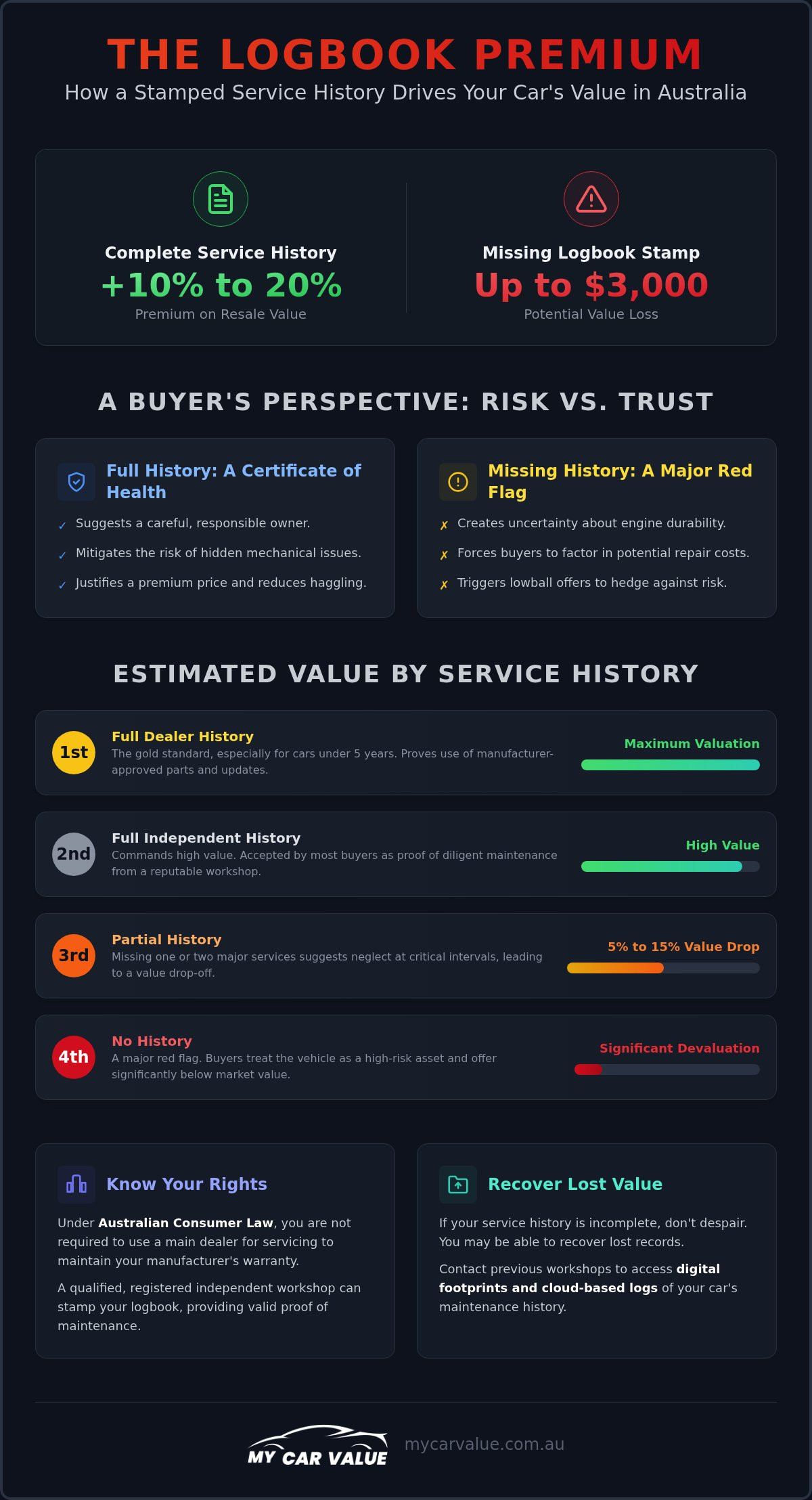
- A complete service history can add a 10% to 20% premium to your car’s resale value, protecting you from significant financial loss.
- Discover exactly how service history affects car value australia and why professional buyers use these records to justify higher offers.
- You aren’t required to use a main dealer for servicing; qualified independent workshops can stamp your logbook without voiding your manufacturer’s warranty.
- Recover lost maintenance records by accessing digital footprints and cloud-based logs from previous Australian workshops.
- Calculate your car’s true market worth by using the Value My Car service to account for your vehicle’s specific maintenance profile.
The Financial Delta: Quantifying Service History in the Australian Market
The Service History Gap is the price difference between two identical models with different maintenance records. In the Australian market, this gap translates to real dollars. A complete, stamped logbook creates a “Logbook Premium” that can add between 10% and 20% to your car’s resale value. Professional buyers view a full history as a proxy for the vehicle’s overall health. It suggests a “careful owner” who hasn’t cut corners on essential upkeep. This psychological factor is powerful; a buyer who trusts the records is far more likely to pay a premium price without haggling.
Understanding car valuation requires looking beyond just the make and model. When services are missed, the vehicle doesn’t just lose value for the cost of the service itself. It suffers a compounding discount. As a car ages, the lack of early records creates uncertainty about the engine’s long-term durability. This uncertainty forces buyers to lower their offers to cover potential mechanical failures. Missing a major 100,000km service, for example, signals that expensive components like timing belts may be overdue for replacement.
Estimated Value Loss by Service Gap
Your vehicle’s valuation depends heavily on the consistency of its records. Professional buyers categorise history into four main tiers:
- Full Dealer History: This remains the gold standard for maximum valuation, particularly for cars under five years old. It proves the vehicle has received manufacturer-approved parts and software updates.
- Full Independent History: This still commands high value. As long as the workshop is reputable and registered, most professional buyers accept this as proof of diligent maintenance.
- Partial History: Expect a 5% to 15% value drop-off. Missing just one or two major services suggests the vehicle has been neglected at critical intervals.
- No History: This is a major red flag. Without records, professional purchasers often treat the vehicle as a “wholesale-only” asset, offering significantly less than market value to hedge against risk.
Why 2026 Market Trends Prioritise Maintenance
In 2026, the Australian market is more sensitive to maintenance than ever before. Modern vehicles feature complex engine technologies and sophisticated sensors that require precise calibration. If you miss a service, these systems can degrade, leading to expensive repairs that far outweigh the cost of a standard logbook service. Buyers use service history to filter out “lemon” vehicles. A well-maintained car also maintains better fuel efficiency and lower emissions, which are high priorities for today’s budget-conscious drivers. Once you understand how service history affects car value australia, the next step is to use a professional tool like Value My Car to see where your vehicle stands in the current market.
Logbook vs. Basic Service: Why the “Stamp” Matters to Professional Buyers
A logbook service is far more than a simple oil change. It is a comprehensive maintenance schedule mandated by the manufacturer to ensure every safety system and mechanical component functions correctly. Professional buyers prioritise the logbook because it provides a verified paper trail of this upkeep. This record is the most influential factor in how service history affects car value australia. Without a stamped book, a buyer has no way to confirm if critical fluids were flushed or if safety recalls were addressed.
Australian Consumer Law protects your right to choose where you maintain your vehicle. You don’t need to visit a main dealer to keep your manufacturer’s warranty intact. Any qualified independent mechanic can perform the service, provided they follow the factory schedule and use appropriate parts. This flexibility is supported by official government advice, which encourages buyers to verify records regardless of where the work was done. However, for cars still under warranty, a dealer stamp often suggests the vehicle has received the latest technical updates and factory-specific care.
Logbooks also allow buyers to predict looming expenses. If a car is nearing 100,000 kilometres and the timing belt hasn’t been recorded as replaced, a professional purchaser will immediately lower their offer. They view the missing entry as a guaranteed future cost they must absorb. A clean record removes this uncertainty and protects your asking price.
The Anatomy of a “Buyer-Ready” Logbook
Consistency in date and kilometre readings is the first thing a professional looks for. Gaps in the timeline are immediate red flags that suggest periods of neglect. Every entry must clearly display the workshop’s ABN and contact details. Buyers often verify these details to ensure the stamps are legitimate. Major milestones, such as the 60,000km and 100,000km services, act as value anchors that prove the car has been properly prepared for its next phase of life.
Dealership vs. Independent Workshops
Owners of prestige brands like BMW or Mercedes-Benz often wonder if dealer stamps are mandatory for resale. While a dealer history is the gold standard for luxury cars, a specialist independent workshop can be just as effective. Savvy Australian buyers often value a specialist’s deep knowledge of a particular model. When you check your car’s market value, our network of professional buyers considers the quality and relevance of your service source. They look for evidence of expert care rather than just a specific brand name on the stamp.
The Risk Factor: How Missing Records Trigger “Lowball” Offers
Professional buyers apply a specific logic when records are absent. They call it the “Worst Case Scenario” pricing model. If you cannot prove the oil was changed or the brakes were checked, they must assume these tasks were neglected. This assumption forces them to budget for a “major catch-up service” immediately after purchase. They aren’t being difficult; they are protecting their margins against hidden mechanical failures. This approach is a standard part of the industry valuation process.
One of the biggest red flags for a professional is the claim that a car was “just serviced” without a supporting receipt. In the automotive industry, a verbal promise holds zero value. Without a workshop tax invoice or a logbook stamp, that service effectively didn’t happen in the eyes of a valuer. This lack of proof is a primary reason how service history affects car value australia so drastically. Transparency is your best defence against low offers. Linking your service records with a clean PPSR report creates a comprehensive profile that justifies a higher asking price.
The Cost of Uncertainty
Uncertainty is expensive for a seller. When records are missing, buyers must calculate the risk of internal engine sludge or neglected cooling systems. These are high-cost items that can’t always be spotted during a quick inspection. To mitigate this risk, many buyers apply a “Safety Net” discount. This often involves taking an additional $1,000 off the valuation simply because the logbook is missing. Maintaining a clear record is the easiest way to avoid this penalty. For more detail on building trust, see our guide on Car History: Why Transparency Increases Value.
Professional Buyers vs. Private Negotiators
Private buyers are often driven by emotion and fear. If they see a blank logbook, they usually walk away entirely. They don’t have the mechanical expertise to assess the risk, so they choose the safest option: finding another car. Professional buyers operate differently. They use data and market trends to offer a fair price, even with imperfect records. They understand that a car can still be in good condition despite a lost book. Using a platform like My Car Value connects you with professional used car buyers who understand the true worth of your vehicle. They look at the whole picture rather than just focusing on a missing stamp, helping you avoid the stress of private negotiations.
Recovering Lost Value: What to Do if Your Service History is Incomplete
Losing your physical logbook feels like a financial disaster, but you shouldn’t panic. Most modern Australian workshops now maintain a comprehensive digital footprint. Maintenance data is likely stored in cloud-based systems, even if your glovebox is empty. Reconstructing this record is the most effective way to manage how service history affects car value australia. While a statutory declaration can explain a missing period of ownership, it cannot replace the technical certainty of a mechanical record. Buyers need to see what was done, not just hear that it was done.
A 4-Step Plan to Reconstruct Your Records
Start by contacting the original selling dealership or previous owners. Dealerships keep detailed logs of every factory service performed under their roof. They can often print a full history of the vehicle’s life with a single click. If you used a major service centre, request a “Service Summary Printout” which lists every date and kilometre reading on file. These documents carry significant weight with professional valuers. Use secondary evidence to fill the gaps. Annual safety inspections, roadworthy certificates, and tyre replacement receipts provide verified proof of the vehicle’s mileage at specific dates. Finally, purchase a replacement logbook from the manufacturer and ask your regular mechanics to back-stamp it using their digital records. This creates a professional paper trail that satisfies a buyer’s due diligence and restores lost value.
The “Pre-Sale Service” Strategy
If your history has significant gaps that cannot be filled, consider a “pre-sale service.” Paying for a fresh inspection right before you sell provides a current “Condition Report” that proves the car is mechanically sound today. This transparency helps offset the risk associated with a missing history. It shows you aren’t hiding major faults. Combining a recent service with a clear market assessment is essential for a successful sale. Learn more about How to Get a Good Trade-In Price in Australia to see how current condition impacts your bottom line.
Maximising Your Sale Price with My Car Value
Once you have organised your maintenance records, the final step is turning that documentation into a bank transfer. Our Value My Car service is designed to reflect the true worth of your vehicle by accounting for its unique maintenance profile. While generic calculators might ignore your logbook, we ensure your diligence is rewarded. Understanding how service history affects car value australia is only half the battle; you need a platform that translates that data into a competitive offer.
Professional buyers within our network actively seek out vehicles with a transparent history. They view a well-documented car as a “known quantity”, which significantly reduces their financial risk. Because they don’t have to budget for unexpected repairs or “catch-up” servicing, they can afford to offer you a higher price. This efficiency is the core of our Sell My Car solutions. We connect you with Used Car Buyers who prioritise quality and are ready to pay for it.
The My Car Value Advantage
- National Network: Gain access to professional buyers across Australia who are looking for well-maintained stock.
- Real-Time Data: Receive transparent valuations based on current Australian market demand and recent sales.
- Streamlined Process: Save hours of time by avoiding private listings and endless negotiations with unverified buyers.
Ready to See What Your Car is Worth?
Start your valuation today with our easy-to-use online tool. When you enter your vehicle details, be sure to highlight your full service history. Providing these specifics allows our system and buyer network to generate a more accurate and competitive quote. It’s the fastest way to see the direct financial benefit of your logbook stamps. Don’t let your maintenance efforts go unrewarded in a crowded marketplace. Our process ensures you get a fair price without the typical private sale headache.
Secure Your Maximum Resale Value Today
A complete logbook is more than just a record of oil changes; it’s a financial asset that protects you from lowball offers. By maintaining a transparent history, you justify a premium price and build immediate trust with potential purchasers. Even if your records are currently incomplete, taking the time to reconstruct your digital footprint can restore up to $3,000 in market worth. Understanding exactly how service history affects car value australia gives you the leverage needed to negotiate with confidence.
The Australian market in 2026 rewards transparency and diligent maintenance. Don’t let your hard work in keeping your vehicle healthy go to waste by settling for a generic valuation. Connect with our national network of professional buyers who value well-kept cars and offer accurate market valuations in minutes. Our transparent and stress-free selling process is designed to save you time while ensuring you receive a fair price for your vehicle’s unique profile.
You’ve done the work to maintain your car. Now it’s time to see that effort reflected in your bank balance.
Frequently Asked Questions
Does a missing service history really devalue a car in Australia?
Yes, it significantly impacts the final sale price. A missing logbook can reduce a car’s resale value by 10% to 20% because buyers view a lack of records as a major risk factor. It suggests that critical maintenance might have been ignored, forcing purchasers to lower their offers to cover potential mechanical failures. Maintaining a complete record is the most effective way to protect your vehicle’s market worth.
Can I sell my car if I have lost the logbook?
You can certainly sell your car without a physical logbook. However, you should expect lower offers from private buyers who often lack mechanical expertise and fear hidden faults. To mitigate this, use digital records from your previous workshops to prove maintenance. Professional buyers are often more flexible if you can provide a “Service Summary Printout” or other verifiable documents that confirm the vehicle’s upkeep history.
Is dealership service history better than an independent mechanic for resale value?
A dealership stamp is often the gold standard for vehicles under five years old or those still under warranty. It proves the car received manufacturer-specific parts and software updates. However, for older vehicles, a reputable independent mechanic’s stamp is perfectly acceptable. Australian Consumer Law protects your right to use independent workshops without voiding your warranty, provided they follow the official manufacturer schedule and use fit-for-purpose parts.
How much does one missed service affect my car’s value?
A single missed service can lead to a value drop of 5% to 15% depending on the vehicle’s age. It creates a gap in the maintenance timeline that raises red flags about engine health and long-term durability. If the missed service was a major milestone, such as a 100,000km check, the impact is even more severe. Buyers often assume the worst and discount their offers to account for neglected components.
What is the difference between a logbook service and a basic oil change?
A logbook service is a comprehensive inspection and maintenance routine mandated by the manufacturer. It includes checking safety systems, flushing fluids, and replacing specific parts based on kilometres or time. A basic oil change is a minor procedure that only addresses engine lubrication. Understanding how service history affects car value australia requires recognising that professional buyers specifically look for the full logbook checklist rather than just simple oil changes.
Do professional car buyers check the service history?
Yes, professional buyers perform thorough due diligence on every vehicle. They use the logbook to verify mileage consistency and to predict upcoming major expenses like timing belts or brake rotors. A transparent history allows them to make more confident, higher offers. If records are missing, they must apply a risk discount to the valuation to protect their margins against hidden mechanical issues that may arise after the purchase.
How can I prove my service history if I do my own maintenance?
Proving self-maintenance is challenging for resale. To maintain value, you must keep all tax invoices for parts, oil, and filters purchased. Document the date and kilometres for every task performed in a dedicated log. While this is better than no history at all, most professional buyers still prefer a stamp from a registered workshop with an ABN. This provides a level of professional accountability that self-servicing typically lacks.
Should I get my car serviced before selling it to a professional buyer?
It depends on the current gap in your records. If your last service was over six months ago, a fresh pre-sale service can increase buyer confidence. It provides a current condition report that proves the vehicle is mechanically sound today. This is particularly useful if your previous how service history affects car value australia profile is incomplete. A recent inspection can help you avoid lowball offers based on mechanical uncertainty.