
Selling Car to Dealer vs Private: The Ultimate 2026 Australian Guide
The highest offer for your vehicle often leaves you with the least amount of money in your pocket once you account for the hidden costs of a private sale. In the 2026 Australian market, the debate over selling car to dealer vs private has shifted significantly. With Chinese brands now dominating the local supply and used EV sales doubling year-on-year, the traditional methods of offloading a vehicle are more complex than ever. You might think a private listing is the only way to get a fair price. The reality of 2026 is often defined by weeks of no-shows and expensive mechanical certifications.
It’s frustrating to spend your weekends dealing with tyre-kickers who vanish the moment you mention a PPSR check or a roadworthy certificate. You want a secure transaction that doesn’t involve a mountain of paperwork or the risk of odometer fraud. This guide will show you how to maximise your return while minimising the friction of the selling process. We’ll compare the immediate speed of professional buyers against the potential margins of the private market, giving you a clear path to a fast and fair sale.
Key Takeaways
- Evaluate the trade-offs between immediate speed and potential profit to choose the most efficient selling method for your current situation.
- Navigate the 2026 Australian market by understanding how the rise of Chinese brands and used EVs affects selling car to dealer vs private.
- Identify the hidden costs of private sales, including the time spent managing “tyre-kickers” and the legal requirement for state-specific mechanical certifications.
- Learn how professional buyers use real-time auction data to provide instant offers and “as-is” purchases that eliminate paperwork friction.
- Start the process with a “Value My Car” digital valuation to secure an accurate, data-driven estimate of your vehicle’s current market worth.
Selling Your Car in 2026: The Dealer vs Private Sale Dilemma
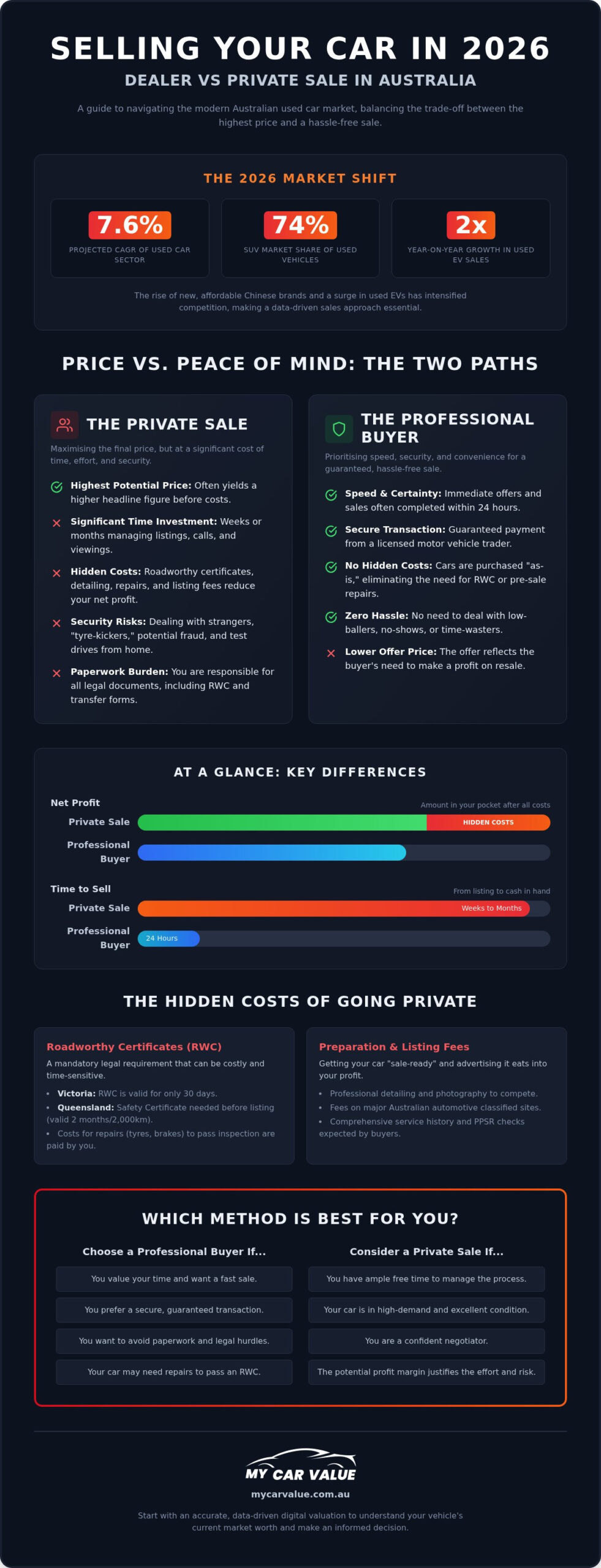
The decision of selling car to dealer vs private is no longer just about the final figure on a bank statement. In 2026, the Australian used car market has transformed. China has overtaken Japan as our primary vehicle supplier, and the surge in used EV listings has made traditional pricing methods obsolete. You now face a choice between chasing the highest possible return or prioritising a secure, immediate exit. This “Price vs. Peace of Mind” trade-off is the foundation of every successful sale in the current climate.
The 2026 market requires a data-driven approach. With the used car sector projected to grow at a CAGR of 7.6%, buyers are more discerning than ever. They compare your used vehicle against feature-rich, affordable new models from brands like BYD and MG. If you choose the private route, you must be prepared for longer listing times and increased competition. If you choose a professional buyer, you trade a margin for the certainty of a same-day result.
What is a Private Sale?
A private sale involves listing your vehicle on platforms like Facebook Marketplace or specialized classified sites. You act as the salesperson, photographer, and administrator. While this method often yields a higher price, it requires a significant time investment. You must handle every enquiry, filter out tyre-kickers, and ensure all legal paperwork is correct. In 2026, with SUVs holding over 74% of the used market share, standing out requires professional-level effort. You are also responsible for the vehicle’s roadworthiness and the security risks associated with hosting test drives at your home.
What is Selling to a Dealer or Professional Buyer?
Selling to a licensed motor vehicle trader or a modern network of Used Car Buyers is built for speed. These businesses purchase your car to resell it for a profit. They provide immediate liquidity and assume all mechanical and administrative risks. You don’t need to organise a roadworthy certificate or worry about the sale falling through at the last minute. This category now includes professional digital buyers who use real-time data to provide competitive offers. If you want to Sell My Car in Brisbane, Sydney, or Melbourne, these networks offer an “as-is” transaction designed to strip away the complexity of the process.
Ultimately, the right choice depends on your specific goals. If you have the patience to manage a weeks-long process for a few extra dollars, the private market remains an option. However, if you value your time and want to avoid the anxiety of paperwork and PPSR transfers, professional buyers provide a streamlined alternative. This guide will break down the mechanics of both methods to help you decide which path fits your 2026 lifestyle.
The Private Sale Route: Maximising Price at the Cost of Time
Choosing the private market is often driven by the desire for a higher sticker price. However, the process of selling car to dealer vs private in 2026 requires more than just a “for sale” sign in the window. You’ll need to invest in professional detailing and high-resolution photography to compete with the flood of new models entering the market. A vague description won’t cut it. Modern buyers are data-hungry. They expect a comprehensive service history and a clear explanation of the vehicle’s condition before they even consider a viewing.
Hosting test drives at home carries inherent security risks. You are essentially inviting strangers to your property, often at times when you may be alone. Beyond security, you’ll face “tyre-kickers” who have no intention of buying or lowballers who offer half your asking price before seeing the car. Negotiation in the private market is often aggressive and exhausting. Before you commit to a private listing, it is wise to Value My Car to see if the potential profit margin justifies the extra labour.
The Hidden Costs of Going Private
Passing a roadworthy inspection is a major hurdle that many sellers underestimate. In Victoria, a Certificate of Roadworthiness (RWC) is valid for only 30 days. In Queensland, a safety certificate is mandatory before you even list the car and remains valid for two months or 2,000 km. If your vehicle requires new tyres, brake pads, or suspension work to pass, these costs eat directly into your profit. When you add listing fees on major Australian automotive platforms and the “opportunity cost” of spending your weekends fielding no-shows, the financial gap between a private sale and a dealer offer often narrows significantly.
Legal Obligations and Paperwork
A PPSR check currently costs $2.00 and is a non-negotiable step for any serious private buyer in 2026. This report proves your vehicle has no outstanding finance and hasn’t been written off. You are also responsible for drafting a compliant contract of sale and managing the transfer of registration. According to this official government guide, sellers in New South Wales must submit a Notice of Disposal within 14 days of the sale to avoid being held liable for future fines or tolls. Managing the risk of payment fraud is another concern; fake bank transfers and “overpayment” scams are increasingly sophisticated, requiring you to be hyper-vigilant during the final transaction.
Selling to a Dealer or Professional Buyer: The Speed Advantage
The primary advantage of selling to a professional buyer is the compression of time. In the ongoing debate of selling car to dealer vs private, speed is the decisive factor for many Australian car owners. Professional buyers use real-time auction data to generate offers that reflect current demand in 2026. This data-driven approach ensures you receive a market-competitive price without the week-long wait of a private listing. You skip the preparation phase entirely. There is no need for professional detailing or high-end photography when the buyer is an industry expert.
One of the biggest reliefs is the “as-is” purchase model. Dealers and professional buyers assume the mechanical risk. You don’t need to spend money on new tyres or a major service just to pass a roadworthy test. You also conduct the transaction in a secure, neutral business environment. This eliminates the risk of inviting strangers to your home and protects you from the rising trend of payment fraud in the private market. You receive your funds via secure bank transfer, often before you’ve even left the office.
Why Professional Buyers Beat Traditional Trade-ins
Many people confuse professional buyers with traditional dealership trade-ins. A trade-in is usually a secondary part of a new car purchase. This can often hide the true value of your vehicle through complex “over-allowances” or discounts on the new car. Professional buyers offer a clean exit. They focus solely on your vehicle’s value, providing a transparent cash offer without forcing you into a new finance contract. This is particularly useful for high-demand SUVs or niche models that might fetch a better price through a national network of used car buyers.
The Seamless Paperwork Process
The administrative burden of a sale is where most private sellers stumble. Professional buyers handle the entire process for you. They lodge the Notice of Disposal and transfer the registration instantly. If you still have money owing on the car, the buyer manages the payout directly with your financier. This removes the anxiety of coordinating bank cheques or waiting for finance clearances. This Consumer Affairs Victoria guide highlights that while private sellers must provide specific documentation, selling to a licensed dealer shifts those legal obligations away from you. You walk away with a receipt and a clear bank transfer, usually on the same day.
Key Factors That Dictate Your Best Selling Method
Choosing between selling car to dealer vs private isn’t a one-size-fits-all decision. Your vehicle’s specific profile dictates which path will yield the most efficient result. A three-year-old SUV with low kilometres attracts different buyers than a fifteen-year-old hatchback with a patchy service history. You must also consider your personal timeline. If you’re moving overseas next week, a private sale is a high-risk gamble. If you have months to spare, you might tolerate the administrative grind for a slightly higher return.
Mechanical condition is another pivot point. Professional buyers accept cars in almost any state, provided the price reflects the work needed. Private buyers, however, usually demand a “retail ready” vehicle. If your car needs a $2,000 transmission fix to pass a roadworthy, selling to a dealer saves you from paying that cost upfront. Additionally, car finance complicates things. If you have “negative equity”, where you owe more than the car is worth, a professional buyer can often facilitate the gap payment more securely than a private individual.
Vehicle Category Comparison
- Near-New Vehicles (1-3 years): Dealers love these for their showrooms. Private buyers often struggle to secure $50,000 or more in cash or face bank transfer limits. This makes professional buyers the safer bet for high-value assets.
- The “Sweet Spot” (4-8 years): These are the bread and butter of both markets. Your choice here depends entirely on whether you value your Saturday mornings more than a potential 5% price premium.
- Older or High-KM Vehicles: If your car is worth less than $8,000, the private market is often your best bet for a higher return. Dealers usually wholesale these older units, which can lead to lower offers.
The “Market Value” Reality Check
Don’t confuse the “Asking Price” you see on classifieds with the “Actual Sale Price”. Most private listings include a 10% to 15% negotiation buffer that disappears during the final handshake. To get a realistic baseline, use a vehicle market value calculator. This tool uses real-time data to estimate what buyers are actually paying in 2026. A professional valuation provides the only objective way to compare a dealer’s “as-is” offer against a potential private return.
How My Car Value Simplifies the Australian Selling Process
My Car Value acts as a savvy digital intermediary, stripping away the complexity of a traditionally stressful process. We provide the essential bridge between individual sellers and a national network of professional purchasers. In the 2026 market, the dilemma of selling car to dealer vs private often comes down to who has the best data. Our platform delivers that data directly to you, ensuring you don’t enter a negotiation blind. We’ve modernized the legacy system of vehicle sales to prioritize transparency, utility, and speed.
Whether you are located in a major metro hub or a regional centre, the platform offers a logical, step-by-step path to a successful sale. You no longer need to rely on anecdotal advice or outdated price guides. By using real-time market insights, we provide immediate clarity on what your vehicle is worth in the current climate. This pragmatic approach values your time and provides a secure alternative to the unpredictable nature of private listings.
Getting Your Valuation
The process begins with a few simple details. Input your vehicle’s VIN, its current condition, and the odometer reading to receive a data-driven estimate. This isn’t a generic guess; it’s a precise valuation based on actual 2026 sales data for similar models across Australia. This information empowers you to negotiate with absolute confidence. If you’ve decided to sell my car, this valuation is your most powerful tool. It allows you to compare private offers against professional bids with total mathematical certainty.
Connecting with the Right Buyer
Skip the exhausting car yard crawl and let the buyers come to you. Our platform connects you with a vetted network of professional Used Car Buyers who are actively looking for stock. This service covers all Australian states and territories, from Perth and Adelaide to Sydney, Melbourne, and Brisbane. You get the speed of a dealer transaction combined with the competitive pricing of a wide buyer network. It’s a streamlined, professional experience that removes the friction of paperwork and the anxiety of payment security.
Take the first step toward a hassle-free sale and move on to your next vehicle with total confidence.
Frequently Asked Questions
Is it better to sell a car to a dealer or privately in Australia?
The better method depends on whether you value your time or a potential price premium. When considering selling car to dealer vs private, a private sale might return more cash but requires a significant time investment. Dealers offer immediate liquidity and assume all mechanical risks; this makes them the better choice for a secure, same-day exit without the stress of managing enquiries.
Do I need a Roadworthy Certificate (RWC) to sell my car to a dealer?
You typically do not need a Roadworthy Certificate (RWC) when selling to a licensed dealer. Dealers buy vehicles in “as-is” condition and handle the necessary repairs and inspections through their own service centres. This saves you the upfront cost and the hassle of visiting a mechanic, which is a mandatory requirement for private sales in most Australian states.
How much less will a dealer pay for my car compared to a private sale?
Dealers generally offer a lower price than the private market to account for their business overheads and reconditioning costs. While you might see a 10% to 15% difference in the offer, you must factor in the hidden expenses of a private sale. Listing fees, professional detailing, and mechanical repairs required for a safety certificate can narrow the gap when selling car to dealer vs private.
Can I sell a car that still has finance on it to a professional buyer?
Yes, professional buyers routinely purchase vehicles with outstanding finance. They simplify the process by contacting your financier directly to obtain an official payout figure. The buyer pays the lender the remaining balance and transfers any surplus amount to your bank account. This eliminates the complexity of coordinating bank cheques or waiting for finance clearances that often complicates private transactions.
What paperwork do I need to sell my car privately in 2026?
Private sellers in 2026 must provide a clear PPSR report, which currently costs $2.00, to prove the vehicle has no financial encumbrance. You also need a signed contract of sale and a valid safety certificate in states like Queensland or Victoria. In New South Wales, you must lodge a Notice of Disposal within 14 days of the sale to ensure you are no longer liable for the vehicle’s future fines.
How do I avoid scammers when selling my car on the private market?
Prioritise secure payment methods and neutral meeting locations to avoid common private sale scams. Never release the vehicle or the keys until you have confirmed the cleared funds are in your bank account; do not rely on digital screenshots of transfer receipts. Be wary of buyers who offer to pay more than your asking price or those who refuse to inspect the car in person before sending money.
What is the fastest way to sell my car in Australia?
Selling to a professional buyer network is the fastest method available in Australia. These platforms use real-time market data to provide instant offers and can often complete the inspection and payment within 24 hours. This is significantly quicker than the private market, where the average listing time has increased in 2026 due to the high volume of new Chinese brands and used EVs entering the supply chain.