

Documents Needed to Sell a Car in Australia: The 2026 Seller’s Checklist
Most Australians think the hardest part of selling a car is finding a buyer, but the real deal-breaker is actually the paper trail. Selling a vehicle across state lines or even within your own suburb often feels like a bureaucratic nightmare. You’re likely worried about being stuck with someone else’s speeding fines or wondering how to handle a sale with remaining finance. Knowing the exact documents needed to sell a car australia requires can be the difference between a same-day sale and a week of administrative headaches.
We agree that the current state-by-state variations are unnecessarily confusing. This 2026 checklist removes the guesswork by providing a clear breakdown of every form and certificate you need to finalise your sale. We’ll show you how to build a “Transaction-Ready Folder” that handles everything from NSW Pink Slips to Victorian Roadworthies. You’ll gain a step-by-step guide to transferring ownership legally in every state and territory. This ensures a seamless process that protects your liability, clarifies your obligations, and saves your time.
Key Takeaways
- Confirm your legal right to sell by organising your current Australian Driver Licence and Certificate of Registration before listing your vehicle.
- Master state-specific safety requirements, including the 30-day validity window for Victorian RWCs, to ensure a legal and fast transfer of ownership.
- Identify the specific documents needed to sell a car australia buyers require to verify a clean title, including PPSR reports and finance payout letters.
- Protect yourself from future liabilities and traffic fines by correctly lodging a Notice of Disposal immediately after the keys change hands.
- Learn how selling to professional used car buyers simplifies the process by shifting the heavy administrative lifting away from the seller.
The Universal Essentials: Documents Every Australian Seller Needs
Preparing the right paperwork is the first step toward a successful sale. While each state has unique requirements, certain documents are universal across the country. Gathering these early ensures you don’t lose a buyer due to administrative delays. The primary documents needed to sell a car australia requires start with your proof of identity and current registration.
Your current Australian Driver Licence is your most vital tool. It proves you are who you say you are and matches the seller details on the transfer forms. Alongside this, you must produce the Certificate of Registration. This document is the foundation of vehicle registration in Australia and proves you have the legal right to dispose of the asset. If you’ve lost your paper copy, most state authorities allow you to download a digital version via their respective transport apps.
Proof of Identity and Ownership
Your name on the registration must match your photo ID exactly. If there’s a discrepancy, such as a name change through marriage, have your supporting documents ready. For vehicles registered in a company name, you’ll need an ASIC extract and a letter of authority on company letterhead. Sales involving deceased estates or family members require additional legal proof, such as a Grant of Probate or a signed Power of Attorney. Professional used car buyers through My Car Value can often guide you through these complex scenarios to ensure the transfer is legally sound.
Service Records and Manuals
A complete logbook history is more than just a record; it’s a value-add that can justify a higher asking price. Buyers want to see that the vehicle has been maintained according to manufacturer schedules. Organise your receipts for major repairs like timing belts, new tyres, or brake replacements. Providing the original manufacturer manuals also adds to the perceived care given to the vehicle. These records demonstrate transparency and build the trust necessary for a fast transaction. An accurate valuation from My Car Value helps you understand how much this service history actually adds to your bottom line.
Finally, you must create a Bill of Sale. This serves as your legal paper trail. It should include the date of sale, the final price, the vehicle’s VIN, and the contact details of both parties. This simple document protects you if disputes arise after the keys change hands. It’s a pragmatic step that ensures both the buyer and seller have a recorded point of reference for the transaction.
State-by-State Safety Certificates: Navigating Regional Rules
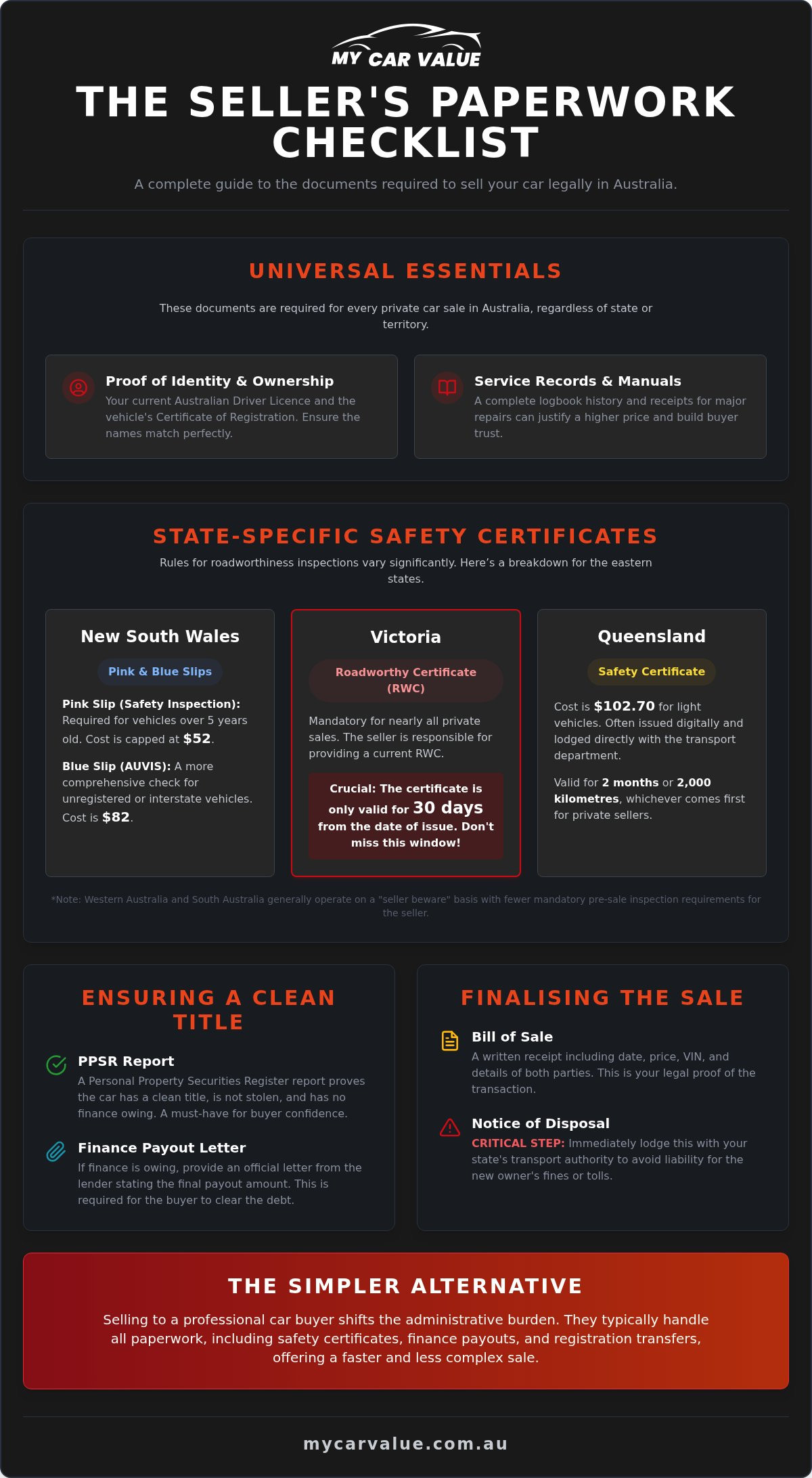
Regional variations are where most sellers encounter delays. Every state has its own rulebook regarding roadworthiness and safety inspections. In New South Wales, vehicles older than five years require an annual safety inspection, commonly known as a Pink Slip, which has a maximum fee of $52. If your car is currently unregistered or from interstate, you’ll need a more comprehensive Blue Slip inspection ($82) to verify its identity and safety. Victoria operates under a different system. A Roadworthy Certificate (RWC) is mandatory for almost all private sales. When selling a vehicle in Victoria, you must lodge the transfer within 30 days of the certificate being issued. If you miss this window, the document becomes void and you’ll need to pay for a new inspection.
Queensland sellers must obtain a Safety Certificate, which costs $102.70 for light vehicles. For private sellers, this is valid for two months or 2,000 kilometres. The state has moved toward digital inspection reports, which are automatically lodged with the Department of Transport and Main Roads. These certificates are among the most critical documents needed to sell a car australia requires to ensure a legal transfer of ownership. Before committing to these costs, it’s wise to get a professional car valuation in Melbourne or your local capital to ensure the vehicle’s market price justifies the potential repair bills.
Eastern Seaboard Requirements (NSW, VIC, QLD)
Market etiquette generally dictates that the seller pays for the safety inspection. If your vehicle fails, you typically have 7 to 14 days to rectify the issues and return for a re-inspection without paying the full fee again. This process is mandatory in NSW, VIC, and QLD even if the buyer offers to take the car “as is.” Skipping these steps can lead to the transport authority refusing the registration transfer, leaving you legally liable for the vehicle.
Western and Southern Australia Procedures
Western Australia and South Australia operate on a “Seller Beware” landscape. In these states, a mandatory safety certificate is generally not required for the sale of a registered vehicle. This places the burden of proof on the buyer. However, savvy buyers often request a voluntary third-party inspection from the RAC or a local mechanic. Providing one of these reports upfront can be a powerful selling point. Western Australia uses an efficient online system for registration transfers, where both parties can lodge their “Notification of Change of Ownership” through the Department of Transport website for a $20.50 fee. While the paperwork is lighter, transparency remains the key to a fast sale.
PPSR Reports and Finance: Ensuring a Clean Title
A clear title is the cornerstone of any legal vehicle transaction. In 2026, buyers are more informed than ever, and most will perform their own due diligence before inspecting a vehicle. The Personal Property Securities Register (PPSR) is the national database used to check if a car has any “encumbrance,” which means a bank or lender has a financial interest in the asset. Providing this information upfront is a critical part of the documents needed to sell a car australia buyers expect to see. It proves the vehicle isn’t stolen, isn’t recorded on the Written-Off Vehicles Register (WOVR), and is free from debt.
The PPSR Certificate Explained
While a buyer can run a PPSR check for $2.00, providing your own certificate builds immediate trust. It shows you’re a transparent seller with nothing to hide. An encumbrance on the report indicates that the car is currently serving as security for a loan. If your car is encumbered, you must resolve this before or during the sale to transfer a “clear title” to the new owner. For a more technical breakdown of how these reports function, refer to our PPSR check guide. Dealing with a WOVR status is more complex; if a car was previously written off and repaired, this must be disclosed to avoid legal repercussions after the sale.
Clearing Finance Before the Sale
Selling a car with “money owing” is a standard process, but it requires specific paperwork to execute correctly. First, contact your lender to obtain an official payout letter. This document states the exact amount required to discharge the loan and includes a validity date. You cannot simply rely on the balance shown in your banking app; the payout figure often includes interest calculations and discharge fees that differ from the daily balance.
Once you have the payout letter, you can facilitate a three-way transaction. In this scenario, the buyer pays the payout amount directly to your lender and the remaining balance to you. This provides the buyer with peace of mind that the debt is settled immediately. After the payment is processed, ensure your lender updates the PPSR database to remove the security interest. This update can take several business days. If this administrative process feels overwhelming, professional used car buyers through My Car Value specialise in handling financed vehicles. They can coordinate directly with your bank to settle the debt and manage the paperwork, ensuring a seamless transition without the stress of managing multiple payments.
Finalising the Transaction: Bill of Sale and Transfer Forms
Handing over the keys is the final act, but the paperwork secures your exit. This stage involves the specific documents needed to sell a car australia requires to legally sever your connection to the vehicle. Without these, you remain liable for what happens next. Completing the transaction correctly ensures that the legal responsibility for the car shifts to the buyer the moment they drive away. It’s a simple process if you follow a methodical sequence.
The Bill of Sale Checklist
A Bill of Sale is your primary record of the transaction. It acts as a receipt and a legal contract between two private parties. To ensure it’s robust, you must include six essential details. Record the vehicle’s VIN and engine number accurately. State the final agreed sale price and the exact date and time of the transaction. You also need the buyer’s full name, residential address, and driver licence number. Finally, ensure both parties sign the document and keep a copy for your records.
Including a “sold as seen” or “as is” clause is a pragmatic step for private sellers. This statement confirms the buyer has inspected the vehicle and accepts its current condition at the time of sale. It provides a layer of protection against future claims regarding mechanical issues. While it doesn’t override Australian Consumer Law for dealers, it’s a standard and effective practice for private transactions.
Notifying the Authorities
Most Australian states enforce a 14-day rule for lodging a Notice of Disposal (NOD). This is your “get out of jail free” card. Once lodged, the transport authority records that you’re no longer the person responsible for the vehicle. If the new owner speeds through a camera on the way home, the fine won’t arrive in your letterbox. You can lodge these notices digitally through Service NSW if you’re selling in Sydney or via myVicRoads if you’re in Melbourne.
Managing number plates requires foresight. If you have personalised or heritage plates, you usually can’t just hand them over. You must visit a service centre to swap them for standard plates and pay the associated fees before the buyer arrives. Finally, remove your toll tags and cancel your insurance policy. Leaving a toll tag in the car can lead to weeks of automated charges that are difficult to refund. These small administrative steps prevent a successful sale from turning into a long-term headache.
Selling to Professional Buyers: How to Skip the Paperwork
Managing the administrative side of a private sale is a significant time commitment. You have to draft contracts, verify IDs, and ensure every state-specific form is perfectly completed. Professional buyers drastically reduce the volume of documents needed to sell a car australia requires from you. They act as efficient facilitators who handle the heavy lifting, allowing you to bypass the most stressful parts of the transaction. This approach is designed for speed and legal compliance.
Why Professionals Beat Private Sales for Paperwork
Selling to a professional eliminates the need for you to draft a private Bill of Sale. The buyer provides a formal purchase agreement that meets all regulatory standards. If your vehicle has money owing, the process is even simpler. Instead of you coordinating a complex three-way payment, professional buyers deal directly with your bank. They obtain the payout figure, settle the debt, and provide you with the remaining balance instantly. This removes the risk of errors during the finance discharge process. For a deeper look at this methodical approach, read our used car buyers guide. Furthermore, many professionals buy vehicles “as is,” meaning you don’t have to spend days chasing a Roadworthy Certificate or Pink Slip before the sale.
The My Car Value Process
Efficiency starts with accurate data. Before you engage with buyers, use our tool to get a precise car valuation. This ensures you enter the negotiation with a clear understanding of your vehicle’s worth. Once you have your valuation, My Car Value connects you with a national network of professional buyers. Whether you are in Brisbane, Perth, or Adelaide, we find partners who specialise in fast, compliant transfers. When you use a professional service, the list of documents needed to sell a car australia typically involves shrinks to the bare essentials: your ID and proof of ownership. The buyer manages the PPSR clearance, the registration transfer, and the disposal notice. This pragmatic path ensures you get paid quickly while maintaining total transparency and legal protection.
Secure Your Sale with Confidence
Mastering the documents needed to sell a car australia requires ensures you walk away with cash in hand and zero future liability. You’ve seen that while registration is state-based, the core requirements remain consistent: valid photo ID, proof of ownership, and a clear title. Whether you’re navigating the 30-day validity of a Victorian RWC or the digital lodgement of a Queensland Safety Certificate, being prepared is your best defence against administrative delays. These steps protect your legal interests and build the trust necessary for a fast transaction.
Transitioning to a professional buyer simplifies this entire workflow. By connecting with experts who handle finance payouts and registration transfers, you skip the paperwork hurdles and the risk of post-sale fines. Trusting real-time market data to set your price allows you to move forward with certainty. It’s the most pragmatic way to ensure your vehicle sale is both profitable and legally sound.
Taking these final steps protects your time and your bank account. You’re now ready to finalise your sale with total confidence and a clean slate.
Frequently Asked Questions
Do I need a Roadworthy Certificate (RWC) to sell my car in Australia?
Requirement for a safety certificate depends entirely on your state’s specific regulations. Victoria, Queensland, and the ACT generally mandate a certificate for most private sales. New South Wales requires a Pink Slip for vehicles older than five years. Conversely, Western Australia and South Australia usually don’t require one for registered vehicles. Always confirm the current 2026 rules with your local transport authority before listing your car to avoid sale delays.
Can I sell a car that still has finance owing on it?
You can sell a financed car, but the loan must be paid out to provide the buyer with a clear title. Start by requesting an official payout letter from your lender. You can then coordinate a payment where the buyer pays the bank directly. Professional used car buyers through My Car Value simplify this process by handling the bank communication and debt settlement on your behalf during the transaction.
What should be included in a private car sale receipt or Bill of Sale?
Your receipt should clearly state the date, final price, and the vehicle’s VIN and engine number. Include the full names, addresses, and licence numbers for both the buyer and seller. Adding an “as is” clause is a pragmatic way to define the terms of a private agreement. This document is a vital part of the documents needed to sell a car australia buyers expect to receive as proof of purchase.
How do I notify the government that I have sold my vehicle?
Submit a Notice of Disposal (NOD) or a transfer application to your state’s transport department immediately after the sale. Most states provide an online portal or mobile app for instant lodgement. You typically have 14 days to complete this step. Prompt notification ensures you aren’t held liable for the new owner’s speeding fines, parking tickets, or toll charges incurred after the keys have been handed over.
Do I need to provide a PPSR report to the buyer?
Providing a PPSR report isn’t a legal requirement, but it’s a powerful tool for building buyer confidence. The report proves your vehicle isn’t stolen, written off, or encumbered by undisclosed debt. While savvy buyers often run their own check, including a recent certificate in the documents needed to sell a car australia sellers prepare can justify your asking price and lead to a much faster, transparent negotiation.
What happens to my insurance and registration when I sell the car?
Registration usually stays with the vehicle and transfers to the new owner, but your insurance policy does not. Cancel your insurance or transfer it to your new vehicle the moment the sale is finalised. Remember to remove your e-toll tags and any residential parking permits from the windscreen. The buyer is responsible for paying the transfer fees and any applicable stamp duty to the state transport authority.
Can I sell a car without a current registration certificate?
Yes, you can sell a car without the physical certificate, provided you can prove legal ownership. If your papers are missing, download a digital copy from your state’s transport website or request a replacement from a service centre. Selling an unregistered vehicle often requires a more complex identity inspection. Ensure the vehicle’s registration status is clearly documented in your Bill of Sale to protect both parties from future legal disputes.
Is a handwritten Bill of Sale legally binding in Australia?
A handwritten Bill of Sale is legally binding as long as it contains the essential details of the transaction and is signed by both the buyer and seller. It serves as a formal contract under Australian law. Ensure the document is legible and includes the VIN, the sale price, and the date. While digital forms are increasingly common, a well-drafted paper receipt remains a valid and secure way to finalise a private car sale.